
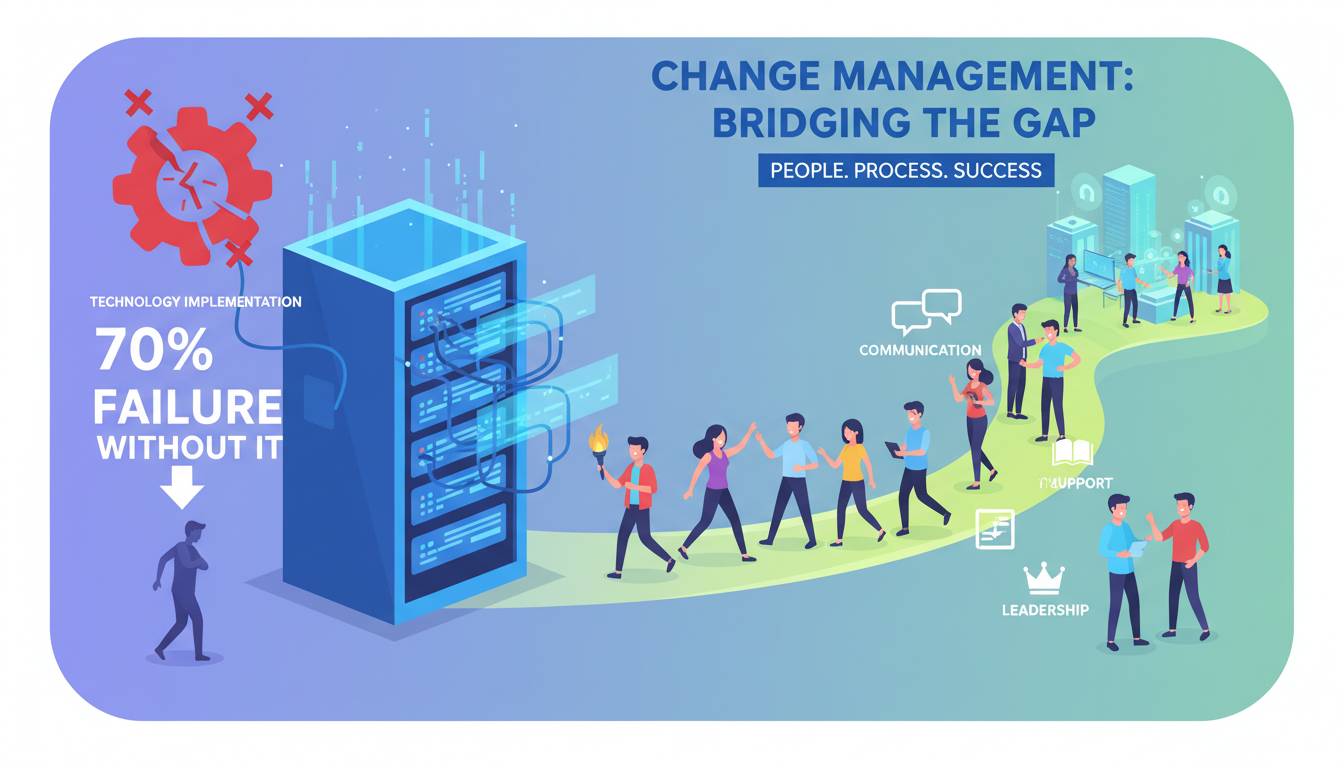
Most technology leaders understand that implementing new software or systems involves technical challenges. What surprises them is how often the failure has nothing to do with the technology itself. The systems work. The code compiles. The infrastructure holds. And yet the project is declared a failure six months later because nobody uses the thing they built. Change management in technology exists precisely to prevent this outcome, and the data suggests most organizations learn this lesson the hard way.
This article will define change management in technology, explain the specific mechanisms by which projects fail when it’s absent, and outline what effective implementation actually looks like in practice. I’ll also address where conventional wisdom gets this topic wrong, because there’s a gap between what most change management guides advise and what actually moves the needle on project outcomes.
What Is Change Management in Technology?
Change management in technology is a systematic approach to managing the human, organizational, and cultural aspects of technology implementations. It exists alongside technical project management but addresses a fundamentally different problem: while technical project management ensures the system gets built correctly, change management ensures the system gets used correctly—and that the organization can sustain its use over time.
The core insight driving this discipline is that technology implementations are never purely technical events. They disrupt established workflows, alter power dynamics, require new skills, and force people to abandon familiar processes. These human dimensions often determine success or failure more than any architectural decision or vendor selection.
Prosci, one of the most widely cited research organizations in this space, defines it as applying methods to manage the people side of change to achieve desired outcomes. In technology contexts, this means coordinating user adoption, stakeholder engagement, communication, training, and resistance management throughout the project lifecycle, and often continuing after go-live when the temptation is to declare victory and move on.
The discipline draws from organizational psychology, communication theory, and behavioral economics. Practitioners use structured frameworks—Prosci’s ADKAR model (Awareness, Desire, Knowledge, Ability, Reinforcement), Kotter’s 8-Step Model, and various proprietary methodologies—to systematically address the human factors that determine whether a technology investment delivers value.
What distinguishes technology change management from general organizational change is the specificity of the technical context. A new CRM system doesn’t just require people to think differently; it requires them to perform specific actions in a specific interface, integrate data from specific sources, and follow processes encoded in specific software workflows. The technical constraints create precise behavioral requirements that pure organizational change initiatives don’t face.
Why Technology Projects Fail Without Change Management
The statistic that gets cited most often comes from McKinsey research: approximately 70% of large-scale technology transformation projects fail to achieve their stated objectives. Other sources, including Gartner and various PMI surveys, cite similar figures in the 50-75% range depending on how “failure” is defined. The consistency across sources isn’t coincidental—something systematic is causing this pattern.
The failure isn’t primarily about bad code or wrong technology choices. When researchers dig into the reasons, a clear pattern emerges: the human and organizational dimensions are consistently underaddressed. Here are the specific failure mechanisms at play.
Lack of User Adoption
The most common failure mode is straightforward: people don’t use the new system. This sounds almost too simple to require explanation, but it deserves serious attention because the causes aren’t always obvious.
User adoption fails for several interconnected reasons. The new system may be genuinely harder to use than the legacy process it replaced, even if it offers long-term advantages. Users may not understand why the change was necessary in the first place, especially if they weren’t consulted during selection. The pain of learning something new may exceed any perceived benefit, particularly if the old way still technically works.
Consider the example of a large healthcare system that implemented a new electronic health records platform. The technical deployment was completed on schedule. The system was feature-rich and met all regulatory requirements. But physician adoption rates remained below 40% six months after go-live. Doctors reverted to workarounds, maintained parallel paper records, and flatly refused to use the new interface during patient visits. The organization had invested heavily in technical implementation and almost nothing in understanding how physicians actually worked or what would motivate them to change their routines.
The lesson isn’t that user adoption is “someone else’s problem.” It’s that adoption must be designed into the project from the beginning, not treated as an afterthought to handle after the system is live.
Resistance and Political Pushback
Technology implementations frequently encounter resistance that has little to do with the technology itself. New systems alter power structures, redistribute decision-making authority, and make previously opaque processes visible. People who benefited from the old way of doing things often resist change not because they’re opposed to progress but because the change threatens their position.
I need to be direct about something: most change management literature underestimates how much political resistance is driven by legitimate concerns rather than simple obstinacy. A department head who opposes a new inventory management system may have legitimate reasons—perhaps the system doesn’t accommodate a real workflow requirement, or perhaps the implementation timeline ignores critical seasonal constraints. Dismissing this as “resistance to change” and applying generic influence techniques misses the point.
Effective change management in technology requires genuinely listening to resistance, distinguishing between self-interested opposition and legitimate operational concerns, and adapting the implementation to address real problems. The goal isn’t to overcome resistance through persuasion tactics—it’s to build a system and a change approach that serve the organization’s actual needs.
Inadequate Training and Support
Organizations frequently underestimate how much training users need and for how long they need it. The assumption that a few hours of classroom instruction plus some quick-reference guides will suffice reflects a fundamental misunderstanding of how people develop proficiency with new tools.
Training failures take several forms. The training itself may be too generic, covering system features without connecting them to specific job tasks. Training may be timed poorly, offered right before go-live when users are already stressed and cognitively overloaded. Support resources may disappear after the first week, leaving users to struggle with problems that emerge later.
A well-documented case comes from the UK National Health Service’s National Programme for IT, one of the largest and most criticized technology implementations in history. Among many problems, the training was widely regarded as inadequate. Clinicians received brief orientations that didn’t reflect the complexity of the clinical workflows they needed to perform. The result was widespread frustration, low adoption, and ultimately a program that was dismantled without delivering its promised benefits.
Poor Stakeholder Communication
Technology projects often fail to maintain effective communication with stakeholders throughout the project lifecycle. This isn’t just about sending status updates; it’s about genuinely engaging stakeholders, understanding their concerns, and keeping them informed in ways that are meaningful to them.
Communication failures include announcing decisions without explaining reasoning, focusing communication on technical milestones instead of business impacts, and failing to create feedback channels that actually influence project direction. Users who feel informed and consulted are far more likely to embrace change than those who feel decisions are being imposed on them.
One manufacturing company I worked with implemented a new ERP system with almost no communication to the shop floor workers who would use it daily. The project team viewed the implementation as a backend optimization and didn’t recognize that thousands of workers would need to interact with the system for their core job functions. When those workers first saw the new system, they viewed it as an imposition from leadership, because that’s exactly how it had been developed and deployed, without any input from them.
The Business Impact of Ignoring Change Management
The cost of failed technology projects extends far beyond the direct investment in software and implementation services. Organizations face opportunity costs from delayed or foregone benefits, productivity losses during transition periods, and the organizational toll of repeated failure.
Research from the Project Management Institute indicates that organizations with mature change management practices are significantly more likely to report project success. Prosci’s benchmarking studies, which collect data from thousands of practitioners annually, consistently show that projects with excellent change management achieve their objectives at roughly twice the rate of those with poor change management.
The financial stakes are substantial. A technology implementation costing $5 million that fails to deliver expected benefits represents more than just a $5 million loss. It means the organization foregoes whatever those benefits would have been, potentially over many years. For large-scale transformations in enterprises, the difference between success and failure can represent hundreds of millions of dollars in value creation or destruction.
There’s also a human cost that gets less attention. Failed technology implementations erode trust between employees and leadership. When people experience a change as poorly managed, confusing, disruptive, and unsupported, they become more resistant to future changes, creating a compounding effect where each failure makes the next change harder.
This is why I think the conventional framing around change management needs recalibration. It’s not about making users “accept” technology they don’t want. It’s about respecting that people deserve to understand what’s changing, why it matters, and how they’ll be supported through the transition. Organizations that treat change management as a box-checking exercise get the results you’d expect from box-checking.
Implementing Change Management in Technology Projects
Effective change management isn’t a separate initiative that runs alongside the technology project. It’s an integral part of how the project is conceived, planned, and executed. Here’s what that looks like in practice.
Start With Impact Analysis
Before selecting technology or designing implementation approaches, conduct a structured analysis of how the change will affect different groups within the organization. This goes beyond job titles to understand specific workflows, concerns, and potential resistance points. The output should be a clear mapping of who will be affected, how their work will change, and what specifically they need to adapt.
This analysis should inform technology selection, not just implementation planning. If the technology that best fits technical requirements is also the one that requires the most dramatic behavior change from users, that trade-off should be explicit in the decision-making process.
Build a Coalition of Advocates
No technology implementation succeeds if the only people advocating for it are in the IT department. Effective change management identifies and develops advocates across the organization, people who are respected by their peers, understand the business context, and can serve as bridges between the project team and end users.
These advocates shouldn’t be shills for the project. Their value lies in their credibility. They can provide honest feedback about what’s working and what isn’t, and their endorsements carry weight because people know they’re not simply echoing vendor messaging.
Design for Adoption From the Start
This is where many organizations go wrong. They treat user adoption as something to figure out during the implementation phase, after the technology has been selected and configured. But technology choices directly affect adoption difficulty.
Design for adoption means involving users in configuration decisions, building feedback mechanisms into the implementation timeline, and planning for a transition period that acknowledges people won’t be productive immediately. It means setting realistic expectations about the learning curve and providing support resources that match the actual difficulty users will face.
One practical step: plan for hypercare. The period immediately after go-live typically requires intensive support resources, dedicated staff available to answer questions, resolve issues, and help users through rough patches. Organizations that treat the go-live weekend as the finish line rather than the starting point of the adoption effort consistently underperform.
Measure and Reinforce Adoption
Change management doesn’t end at go-live. Sustained adoption requires ongoing attention. This means tracking actual usage metrics, not just whether people have logged in but whether they’re using the system as intended, identifying where usage diverges from expectations, and addressing the underlying causes.
Reinforcement includes recognizing and rewarding adoption, addressing persistent barriers, and continuously improving the user experience based on feedback. It also means communicating progress. Showing users that their adoption efforts are producing results helps sustain momentum.
Conclusion
Change management in technology isn’t a nice-to-have addition to already-complex projects. It’s the discipline that determines whether those projects deliver value. The consistent failure rates across industries confirm that most organizations still treat it as secondary to technical concerns.
But here’s the honest acknowledgment I promised: change management alone doesn’t guarantee success. Even excellent change management can’t save a fundamentally flawed technology choice or an unrealistic timeline. The discipline matters, but it operates within constraints set by the broader project context.
The organizations that get this right treat change management as integral to project design, not a separate workstream. They invest in understanding how their people actually work, not just how the new system functions. They’re willing to adapt the technology to fit their organization, not just adapt their organization to fit the technology.
The 70% failure rate isn’t inevitable. It’s a choice—an implicit one made every time an organization prioritizes technical decisions over human ones, every time it treats adoption as someone else’s problem, every time it declares victory at go-live and walks away. Those choices are reversible. The question is whether leadership teams will make different ones.
