
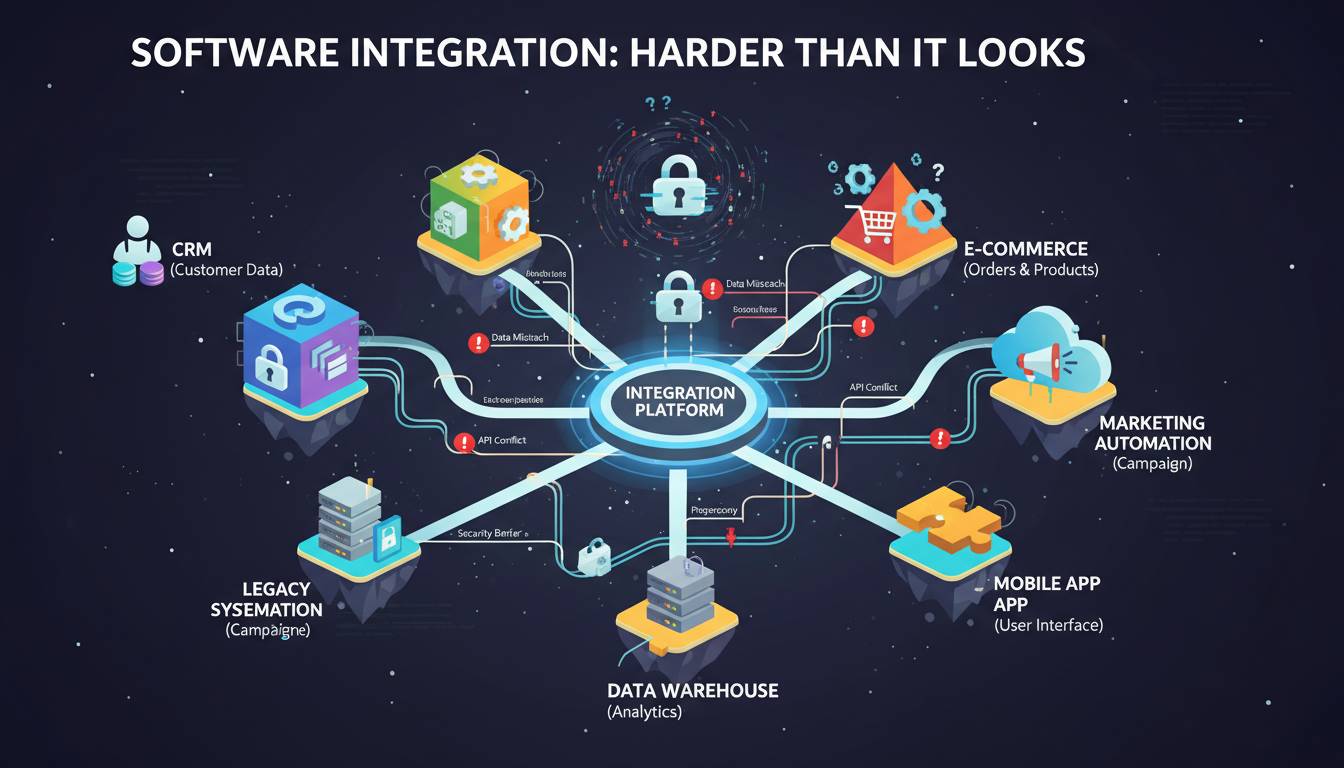
The typical CTO will tell you that their systems are “fully integrated” within the first three minutes of any sales demo. They’re almost always wrong. Software integration—the work of making separate applications talk to each other—is one of the most underestimated challenges in enterprise technology. Most organizations don’t discover how hard it actually is until they’re six months into a project that was supposed to take six weeks.
This isn’t a problem that gets easier with time. If anything, the proliferation of SaaS tools, microservices architectures, and data sources has made integration harder than it was a decade ago. Yet the topic remains surprisingly poorly understood, even among technical professionals. This article covers what software integration actually involves, why it consistently defies expectations, and how to approach it without losing your mind.
What Software Integration Actually Means
Software integration is the process of connecting two or more distinct applications, systems, or platforms so they can exchange data, trigger actions, and operate as a cohesive unit. That’s the textbook answer. The more honest answer is that integration is the work you do when one tool needs to know what happened in another tool—and the two were never designed to speak to each other.
Consider the simplest possible scenario: when a new customer signs up in your CRM, that customer’s information should automatically populate in your billing system, trigger a welcome email from your marketing platform, and create a ticket in your support system. Without integration, someone manually re-enters this data across each platform. With integration, software handles those handshakes automatically. The value is obvious. The difficulty lies in making it happen reliably across dozens of systems, with changing data formats, evolving business requirements, and zero tolerance for errors in financial or healthcare contexts.
The scope of integration ranges from trivial to enterprise-wide. A webhook sending a notification from one app to another is integration. A complex event-driven architecture processing millions of transactions across a hybrid cloud infrastructure is also integration. The principles are similar; the execution could not be more different.
The Technical Foundations That Actually Matter
Understanding integration requires understanding the technologies that make it possible. Skip this section if you already live in API documentation, but pay attention if you’ve ever wondered what actually happens when systems “talk.”
APIs: The Building Blocks (and Their Limits)
APIs—Application Programming Interfaces—are the primary mechanism for modern integration. They define how one piece of software can request data or an action from another. REST APIs dominate the current landscape because they’re relatively straightforward to implement and widely understood. GraphQL has gained ground for scenarios requiring flexible data retrieval, particularly in frontend-heavy applications.
Here’s what most non-technical stakeholders miss: an API is not a stable contract. APIs change. Endpoints get deprecated. Rate limits get imposed without notice. A third-party vendor might decide to sunset an API version you’re depending on, giving you ninety days to rewrite portions of your integration layer. This happens—Twilio, Salesforce, and Slack have all deprecated API versions in recent years, forcing dependent businesses into scramble mode.
Data Formats and Transformation
When systems exchange data, they need a common language. JSON has become the de facto standard for web-based integration, largely displacing XML for new projects. But even within JSON, structure varies wildly. Your CRM might represent a customer address as a nested object with street, city, state, and postal code as separate fields. Your shipping provider might expect a single concatenated string. Your marketing platform might split address into entirely different fields.
This mismatch is what integration professionals call “data mapping,” and it’s where projects go to die. Transforming data between formats isn’t just a technical exercise—it requires deep understanding of business rules. Does a “Suite 200” get mapped to the street address or appended to it? What happens when a customer has a valid address in the CRM but an incomplete one in the billing system? These edge cases multiply faster than anyone plans for.
Authentication and Security
Every integration point is a potential security vulnerability. When you connect two systems, you’re extending trust across a boundary that was previously sealed. The authentication mechanisms vary in complexity: API keys are simplest but offer limited security. OAuth 2.0 provides more granular control, allowing you to grant specific permissions without exposing full credentials. SAML and OpenID Connect handle single sign-on scenarios.
The challenge isn’t just initial implementation—it’s ongoing security management. Credentials expire and need rotation. Permissions need review when employees leave. Third-party integrations become attack vectors when those vendors experience breaches. In 2023, the MOVEit vulnerability demonstrated how a single compromised integration component can cascade across thousands of organizations. The security burden doesn’t end when the integration goes live.
Why Integration Consistently Defies Expectations
Now we arrive at the core of why this topic matters. Most integration projects fail to meet their timeline, budget, or functionality goals. The reasons are systemic, not accidental.
The API Illusion
Vendors advertise their APIs with the same enthusiasm they apply to marketing everything else. “Easy integration,” they promise. “Developer-friendly.” What they rarely mention is that their API documentation might be outdated, their support team might be unresponsive to technical questions, or their API might simply behave differently in production than it does in the sandbox environment.
I worked with a mid-sized fintech company that spent three months trying to integrate with a major payment processor. The API documentation listed every endpoint clearly. The sandbox worked flawlessly. Production was a different story—the payment processor’s production environment had rate limits three times lower than sandbox, different error handling behaviors, and occasionally just timed out without explanation. Their support told the company this was “working as intended.”
This happens frequently. The gap between API promise and API reality is one of the most consistent sources of integration failure. Your integration strategy must account for the probability that external APIs will behave worse than advertised.
The Hidden Maintenance Burden
Integration is not a one-time project. It’s a perpetual operational responsibility that rarely gets budgeted appropriately.
Think about what happens when any of the connected systems updates. Your CRM pushes a new data field. Your marketing platform changes how they handle unsubscribe requests. Your HR system migrates to a new database. Every change in any connected system has the potential to break your integration. The question isn’t whether something will break—it’s when and how quickly you can fix it.
Organizations with mature integration practices treat this maintenance as ongoing work, not occasional troubleshooting. They build monitoring to detect failures before users notice. They maintain redundant integration paths for critical systems. They budget engineering time specifically for integration maintenance, not just new integration development.
Organizations that don’t? They experience integration as a series of crises. A broken sync between CRM and billing goes unnoticed until finance starts asking why revenue numbers don’t match. A failed data import accumulates for days before anyone catches that thousands of records never made it into the system. The direct cost is rework; the indirect cost is eroded trust in data reliability across the organization.
Business Process Misalignment
Technical compatibility is only half the battle. The harder problem is often that business processes don’t align across the systems you’re connecting.
Your sales team uses the CRM to track leads through seven stages. Your customer success team tracks accounts through a completely different lifecycle in a different system. Your billing system has its own logic for when an account is considered “active.” Each system makes perfect sense within its domain. When you try to connect them, you discover that nobody has ever precisely defined what “customer” means across all three contexts. Is a “customer” someone who’s signed a contract? Paid an invoice? Logged into the product?
These definitional conflicts aren’t bugs—they’re features of how organizations actually work. Integration forces you to confront them, usually at the worst possible moment. I’ve seen integration projects stall for months not because of technical obstacles, but because different departments couldn’t agree on shared definitions. The technology was ready; the organization wasn’t.
Real-Time vs. Batch: The Tradeoff Nobody Wants to Make
Integrations can operate in real-time (synchronous) or batch (asynchronous) modes, and the choice has profound implications.
Real-time integration provides immediate data consistency. When a customer updates their address in the CRM, the billing system knows instantly. The user experience is seamless. The cost is complexity and fragility—real-time integrations must handle network failures, timeouts, and duplicate requests gracefully. When something goes wrong, it goes wrong immediately and visibly.
Batch integration defers synchronization to scheduled intervals—perhaps hourly, nightly, or weekly. It’s simpler to implement and more resilient to failures. But it creates windows where systems are out of sync. A customer might receive an invoice to their old address because the billing system still has yesterday’s data.
Most organizations need both. Critical financial transactions often demand real-time sync. Historical analytics might only need nightly batch updates. The mistake is treating all integrations as equally urgent when they’re not, or equally tolerant of delay when they’re not. Defaulting to batch processing where real-time isn’t required is smart; assuming real-time is always better is naive.
Common Integration Patterns and When to Use Them
The industry has converged on several established patterns for tackling integration. Each has strengths and appropriate use cases.
Point-to-point integration connects two systems directly, with no intermediary. It’s simple to understand and implement for a single connection. But it doesn’t scale—each new system requires new connections to every existing system. Ten systems means potentially forty-five unique integrations. This approach works for small-scale scenarios with few systems and low complexity. It collapses under weight.
Middleware and integration platforms (often called iPaaS—Integration Platform as a Service) provide a central hub through which all integrations flow. Workato, MuleSoft, Boomi, and similar platforms handle the plumbing, letting developers focus on business logic rather than infrastructure. This approach suits organizations with moderate to high integration complexity, many systems, and limited appetite for building custom infrastructure. The tradeoff is vendor lock-in and ongoing platform costs.
Event-driven architecture has gained significant traction with modern microservices. Rather than one system calling another directly, systems publish events (something happened) and interested parties subscribe to relevant events. This decouples systems further and handles scale better than synchronous API calls. However, it introduces complexity in event ordering, exactly-once processing, and debugging across distributed systems.
Enterprise Service Bus (ESB) represents the older heavyweight approach—a central bus through which all services communicate. ESB products from IBM, Microsoft, and others dominated enterprise integration for years. They’ve lost ground to lighter-weight approaches, but remain relevant in organizations with heavy legacy infrastructure.
The pattern you choose should depend on your specific constraints, not on what’s fashionable. A three-person startup has different needs than a multinational enterprise.
The Reality of Integration Costs
Here’s a number that surprises almost everyone: integration projects routinely cost three to five times their initial estimates. The pattern is so consistent it borders on universal.
The reasons are predictable once you’ve seen it happen. Initial estimates assume ideal conditions—stable APIs, clear requirements, cooperative vendors, no unexpected edge cases. Reality contradicts every assumption. Vendors change API behavior. Requirements evolve as users understand what they actually need. Edge cases that seemed impossible somehow become common. The last twenty percent of an integration takes eighty percent of the effort.
Budgeting for integration requires acknowledging this reality. Add contingency. Plan for unknowns. Treat your initial estimate as a best-case scenario, not a target. Organizations that build in buffers complete their integrations faster than those that don’t—the pressure to meet unrealistic deadlines creates shortcuts that become technical debt.
What Actually Makes Integration Succeed
After watching dozens of integration projects succeed and fail, certain factors emerge consistently.
Start with clear ownership. Someone must be responsible for the integration’s health. Not the vendor, not the consultant, not the product manager who requested it. An internal owner who understands both the technical and business dimensions. Without clear ownership, integrations drift into nobody’s attention until they break catastrophically.
Invest in monitoring from day one. The moment an integration goes live, something will go wrong. The question is whether you’ll notice. Comprehensive logging, alerting on failure thresholds, and dashboards showing integration health aren’t optional—they’re infrastructure. Build them before you go live, not after.
Document everything. What systems connect, how authentication works, what data flows where, what happens when failures occur, who to contact for each system. This documentation becomes critical the moment someone new needs to debug an issue at 2 AM. It also saves enormous time during any future migration or replacement.
Plan for decommissioning. Every integration will eventually need to be replaced or retired. Building in clean disconnection points—documenting what needs to be undone, what data needs to be migrated, what processes need to be updated—makes future transitions manageable rather than traumatic.
The Path Forward
Software integration isn’t getting easier. The proliferation of tools, the acceleration of vendor changes, and the increasing complexity of data ecosystems all trend toward more integration points and more maintenance burden. If you’re building a technology strategy without accounting for this reality, you’re planning to fail.
The organizations that handle integration best treat it as a discipline, not a project. They build reusable patterns. They invest in the infrastructure that supports ongoing integration health. They staff accordingly. They don’t pretend that integration is someone else’s problem.
Whether you’re evaluating your current integration architecture or planning a new initiative, the question isn’t whether integration is hard. We’ve established that it is. The question is whether you’re building the capabilities to manage that hardness effectively—or hoping it goes away. It won’t go away. But with the right approach, it becomes manageable.
