
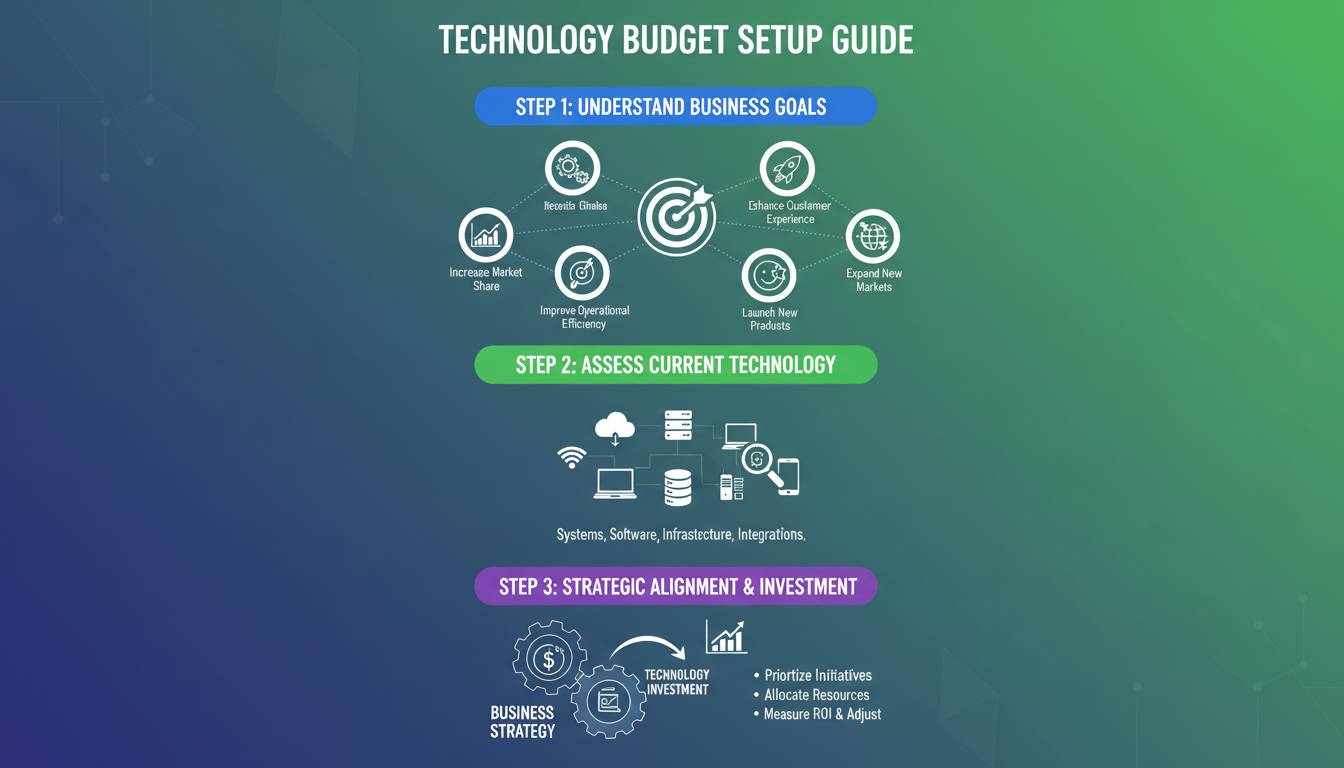
Most companies pour millions into technology without asking the simple question: what business problem does this actually solve? They’ll approve a cloud migration project because it sounds modern, fund a new CRM because the sales team complained, and then wonder why their IT spend keeps climbing while their competitive position stays flat. The disconnect between technology spending and business outcomes isn’t a technology problem — it’s a planning problem. And it has a solution.
This guide walks you through a five-step framework for building a technology budget that directly supports your business objectives. You’ll learn how to translate company strategy into IT investments, prioritize initiatives based on actual business impact, and create a budget structure that makes sense to both technical and non-technical stakeholders. The goal isn’t to spend less on technology. It’s to spend in a way that builds the business you’re trying to build.
Define Your Business Objectives First
You cannot align technology spending with business goals if those goals haven’t been clearly articulated. This sounds obvious, but in practice, most IT budgets are built backwards — they start with last year’s spending plus a percentage increase, or with a list of tools that vendors have been pitching. Neither approach connects to the actual direction of the business.
Start with your company’s strategic plan. Not the IT strategy — the company strategy. What revenue growth is leadership targeting? Which market segments are they prioritizing? Where are they expecting to expand operations, launch new products, or restructure teams? These business-level objectives are the inputs for every technology decision that follows.
If your company is pursuing geographic expansion, your technology budget should reflect infrastructure investments that support new locations — ERP systems that handle multi-country compliance, communications platforms that work across time zones, security frameworks that protect distributed workforces. If the priority is customer experience improvement, budget allocations should flow toward CRM enhancements, customer-facing applications, and data platforms that enable personalization.
The exercise is simple: write down the top three business priorities for the year. Then for each one, ask your IT team to explain exactly how current or planned technology investments support that priority. If they can’t make a direct connection, that line item deserves scrutiny. Gartner’s annual IT budget benchmarking research consistently shows that organizations with explicit business goal alignment in their technology planning achieve 30-40% higher ROI on IT investments than those without — not because they spend differently, but because they spend with intention.
Conduct a Technology Audit
Before you can plan where you’re going, you need to understand where you are. A technology audit inventories your current IT environment, assesses its condition, and identifies gaps between your current state and the state required to support your business objectives.
This isn’t just documentation. It reveals where you’re overspending on redundant systems, where you’re under-investing in critical infrastructure, and where legacy technology is creating business risk. I worked with a mid-size manufacturing company last year that discovered they were paying for eleven different software licenses that performed essentially the same function across different departments. The audit saved them $340,000 annually — money that was immediately redirected toward their actual growth initiatives.
Your audit should cover several dimensions. First, asset inventory: what hardware, software, and cloud services do you currently operate? Second, contract review: what are your recurring costs, renewal dates, and termination clauses? Third, performance assessment: which systems are meeting user needs and business requirements, and which are creating bottlenecks? Fourth, security posture: what vulnerabilities exist, and what would a breach cost in terms of both money and reputation?
The honest answer to “what do we have?” is often embarrassing. Many organizations don’t have a complete picture of their technology footprint. Shadow IT — systems purchased by individual departments without IT involvement — can represent 15-30% of total technology spend, according to various industry estimates. Your budget can’t align with business goals if you don’t even know what you’re spending on.
One important caveat: don’t let the audit become an excuse for paralysis. It’s a starting point, not a destination. You need enough information to make intelligent decisions, not a perfect catalog of every keyboard and cable. Focus on the systems that represent meaningful spend or meaningful business risk.
Prioritize Initiatives by Business Impact
This is where most technology budgets fall apart. You’ve defined your business objectives. You’ve audited your current state. Now you have a list of potential technology initiatives — and that list is longer than your budget can possibly accommodate. How do you decide what gets funded?
The wrong answer is to fund everything at a reduced level, which leaves every initiative underfunded and incomplete. The slightly less wrong answer is to fund based on whoever shouts loudest — typically whoever has the most political capital or the most immediate pain. Neither approach produces meaningful business outcomes.
Instead, evaluate each initiative against two criteria: the business impact it will generate, and the effort required to implement it. Business impact should be quantified where possible — revenue growth enabled, cost savings realized, risk reduced, customer satisfaction improved. Effort encompasses not just the direct cost, but implementation complexity, change management requirements, and opportunity cost of diverting resources from other projects.
This creates a prioritization matrix. High-impact, low-effort initiatives go to the top of your list — these are your quick wins. High-impact, high-effort initiatives require careful evaluation and likely multi-year commitment. Low-impact, low-effort items can be scheduled when capacity allows. Low-impact, high-effort initiatives should be declined or deferred indefinitely.
One point that many organizations resist: you should probably cut more than you fund. If every initiative on your list is a priority, then nothing is a priority. Budget constraints force discipline. Without them, you end up with a technology portfolio that reflects the aggregate of every department’s wishlist rather than a coherent strategy aligned with business direction.
Some CFOs push back on this approach, arguing that technology is infrastructure and shouldn’t be subject to competitive prioritization. That’s a mistake. Every dollar invested in one technology initiative is a dollar not invested in another. The choice is explicit or implicit — but implicit choices are rarely made well.
Build Your Technology Budget Framework
Now you’re ready to construct the actual budget. A well-structured technology budget isn’t a single number — it’s a collection of categories that make sense for your organization and allow for both planning and accountability.
Most technology budgets contain five core categories. Infrastructure and operations covers the foundational elements: cloud services, data centers, networking, security, and the teams that keep systems running. This is your baseline spend — the cost of doing business digitally. For most organizations, this category consumes 50-70% of the technology budget, and it grows roughly in line with overall business activity.
Applications and software includes the tools that employees use to do their work: productivity suites, industry-specific applications, development tools, and licensing costs. This category has been shifting from on-premise software to subscription-based cloud models, which changes the budgeting pattern from large periodic capital expenditures to smaller but predictable recurring costs.
Digital transformation and innovation covers the strategic initiatives that change how the business operates: new platforms, process automation, data and analytics capabilities, customer experience improvements. This is the category most directly tied to business goal alignment — it’s where you fund the projects that create competitive advantage or enable growth.
IT staff and talent is often overlooked as a separate category, but it’s essential. Technology investments only deliver value if you have people capable of implementing, operating, and optimizing them. Budget for the skills you need, not just the tools.
Contingency and governance deserves its own line item. Technology projects frequently encounter cost overruns, timeline delays, or scope changes. Building 10-15% contingency into your budget isn’t pessimistic — it’s realistic. Without it, you either underspend and leave value on the table, or you overspend and create budget chaos.
The key principle here is that your budget structure should tell a story. When you present your technology budget to the board or executive team, the categories should map clearly to the business objectives you defined in step one. If they can’t see the connection, you’ve failed at the framework stage.
Set Review Cadence and KPIs
A technology budget is not a one-time annual exercise — it’s a living commitment that requires ongoing oversight. The most carefully planned budget can still deliver poor results without proper monitoring and adjustment.
Establish a quarterly review cadence. At each review, compare actual spend against planned spend, but more importantly, compare actual outcomes against expected outcomes. Did that customer portal implementation actually improve customer satisfaction scores? Did the new data platform actually enable the analytics capabilities that were promised? Budget variance alone doesn’t tell you whether you’re succeeding — outcome variance does.
Define KPIs that connect technology investment to business results. Mean time to resolution for IT incidents measures operational effectiveness. Project delivery velocity measures execution capability. But the most important KPIs are business-aligned: revenue per employee, customer acquisition cost, time to market for new products, operational efficiency gains. These metrics don’t live in the IT department — they live in the business — but technology investments directly influence them.
One admission that many technology leaders struggle with: you won’t always be able to quantify the business impact of every technology investment with precision. Security spending is particularly difficult to justify on ROI terms — you measure it by what doesn’t happen. Infrastructure investments often have diffuse benefits across multiple business processes. The answer isn’t to avoid these investments, but to be honest about the type of value they provide and the risk they mitigate.
The review process should also account for changes in business direction. If the company pivots strategy mid-year, the technology budget should flex accordingly. Rigid adherence to an annual plan in a changing environment is a mistake. Build flexibility into your budget structure so you can reallocate resources when business priorities shift.
Common Technology Budget Mistakes to Avoid
Learning from your own mistakes is expensive. Learning from others’ mistakes is free. Here are the most common errors I see in technology budgeting, and how to avoid them.
The first mistake is funding technology instead of outcomes. Companies buy software, hardware, and cloud services and then wonder why they haven’t achieved the promised transformation. The technology is the tool, not the result. Your budget should fund business outcomes, with technology as the enabler. If you can’t describe the business outcome, don’t fund the technology.
The second mistake is underestimating total cost of ownership. The purchase price of software is often the smallest component of its cost. Implementation, integration, data migration, training, ongoing administration, and eventual decommission all add significant expense. Budget for the full lifecycle, not just the initial acquisition.
The third mistake is neglecting operational expenditure. Capital expenditure budgets get all the attention, but operational costs often dwarf them. A $50,000 software license is easy to approve. The $200,000 in ongoing costs to run it effectively is where budgets actually get strained. Include operational costs in your planning from the start.
The fourth mistake is ignoring the human element. Technology implementations fail more often due to change management failures than technical failures. Budget for training, communication, process redesign, and user adoption support. These aren’t optional extras — they’re essential components of any technology investment.
The fifth mistake is treating security as an afterthought. Cybersecurity should be a line item in your budget, not a contingency that gets funded only after a near-miss. The average cost of a data breach in the United States now exceeds $4 million, according to IBM’s annual report. That single number justifies significant security investment — and the math doesn’t even account for reputational damage and customer churn.
Conclusion: Aligning Technology Spending with Business Growth
The gap between technology spending and business outcomes isn’t inevitable. It exists because most organizations approach budgeting as a financial exercise rather than a strategic one. They ask “how much do we need to spend on technology?” instead of “what business results do we want technology to help us achieve?”
The framework in this guide reverses that equation. Start with business objectives. Understand your current technology state. Prioritize based on impact. Build a budget that tells a coherent story. Monitor results and adjust course. This isn’t complicated — but it does require discipline and cross-functional collaboration that many organizations struggle to sustain.
Here’s the truth that most technology budgeting guides won’t tell you: you will never have enough budget to do everything you want. The goal isn’t to maximize technology spending or even to optimize it in the abstract. The goal is to make deliberate, defensible choices about where technology investment creates the most business value — and to be willing to cut the initiatives that don’t meet that standard.
The organizations that get this right aren’t necessarily the ones with the largest technology budgets. They’re the ones that spend with clarity about what they’re building and why. That’s the standard worth aiming for.
