
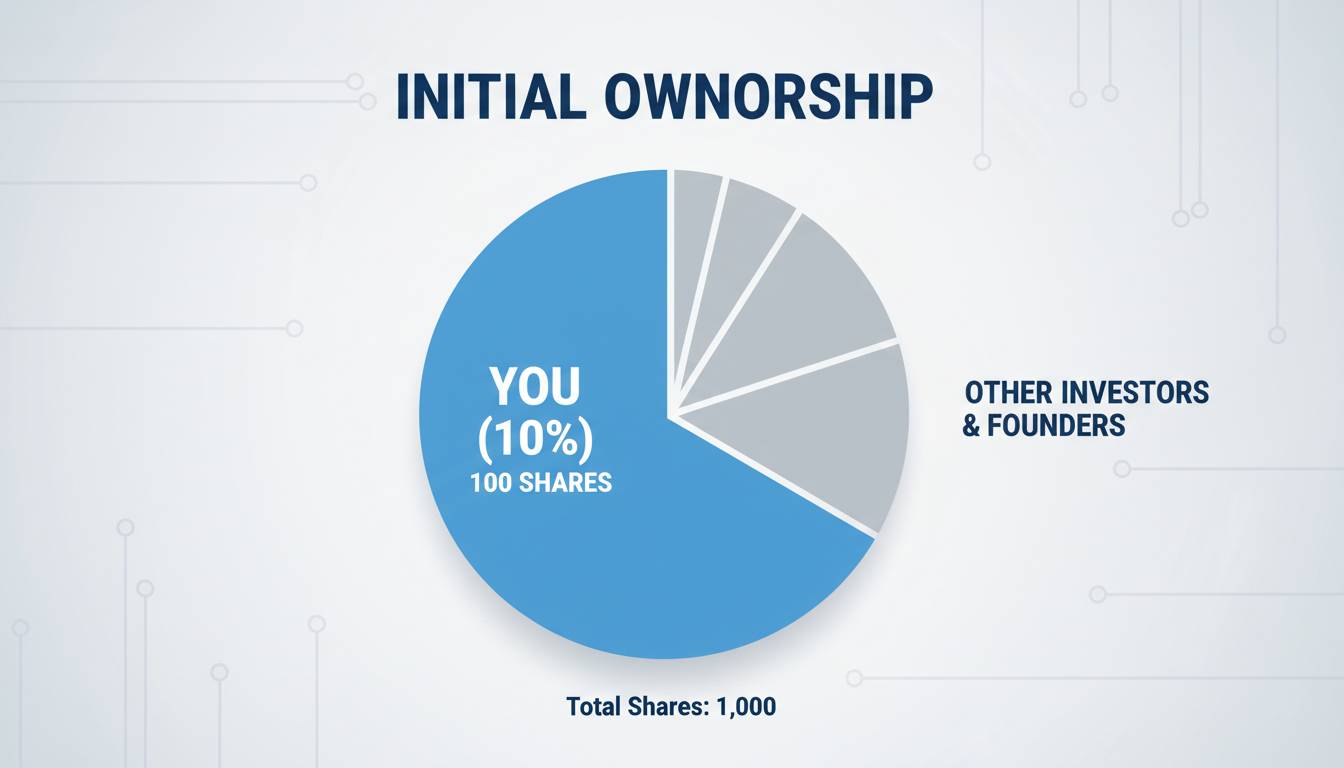
If you’re raising capital for the first time, the moment you sign a term sheet you’ll encounter a number that can feel like a punch to the gut: your ownership percentage is about to shrink. This isn’t a failure. It isn’t even necessarily a bad thing. But misunderstanding how dilution works has ended more founder friendships and startup strategies than almost any other financial concept.
I’ve watched founders refuse reasonable融资条款 because they couldn’t stomach seeing their “ownership” drop from 100% to 60%, not realizing that 60% of a company worth ten times more is mathematically superior to 100% of a company worth nothing. The mechanics are straightforward. The intuition is hard. Let me show you both.
What Dilution Actually Means for Startup Founders
Dilution is the reduction in your ownership percentage that occurs when new shares are issued. That’s the textbook answer, and it’s correct as far as it goes. But understanding why this happens—and whether it matters—requires going deeper.
When you own 100% of your startup pre-funding, you hold all the equity. Let’s say your company is worth $4 million before a venture round. You own $4 million worth of value in absolute terms. Then you raise $1 million from an investor. The company is now worth $5 million post-money (the $4 million pre-money plus the $1 million invested). You now own 80% of that $5 million company—$4 million in value. The math checks out. You haven’t lost a single dollar of value.
But your percentage ownership has dropped from 100% to 80%. That’s dilution.
Here’s where things get confusing: we’re trained to think in percentages. Twenty percent feels like a significant loss. It feels like giving something away. But you’ve traded 20% of ownership for $1 million in capital that presumably builds something worth more than the $4 million you started with. The question isn’t whether your percentage dropped. The question is whether the pie got big enough to make up for your smaller slice.
This distinction—between ownership percentage and total value—is the crux of startup equity. Carta, the cap table management platform, tracks this stuff across thousands of companies. Their data shows the average founder exits with somewhere between 15% and 25% of equity remaining after five or six funding rounds. Those founders aren’t “losing” their company. They’re steering a much larger vessel than they could have built alone.
The Dilution Formula and How to Calculate It
The mathematics of dilution follows a precise formula:
New Ownership Percentage = Original Ownership Percentage × (Pre-money Valuation ÷ Post-money Valuation)
Let’s work through this with real numbers that reflect an actual Series A scenario.
Assume you’re a founder with a seed-stage company. You have a cap table showing you own 70% of the company (the remaining 30% is held by early employees, advisors, and perhaps an angel investor from your seed round). Your pre-money valuation is $8 million. An investor agrees to put in $2 million at that valuation.
First, calculate the post-money valuation: $8 million + $2 million = $10 million.
Now apply the formula:
Your new ownership = 70% × ($8 million ÷ $10 million)
Your new ownership = 70% × 0.80
Your new ownership = 56%
You’ve gone from 70% to 56%. That’s a 14 percentage point drop. In pure percentage terms, you’ve “lost” 20% of your original stake (14 ÷ 70 = 20%). But here’s what actually matters: your 56% stake is now worth $5.6 million (56% × $10 million). Before the round, your 70% stake was worth $5.6 million too (70% × $8 million). The dollar value is identical. The difference is that you now have $2 million in the bank to build the company.
Y Combinator’s startup library makes this point directly: founders should think in terms of value, not percentages. A founder with 20% of a $100 million company has $20 million. A founder with 80% of a $10 million company has $8 million. The math is unambiguous.
For those building financial models, the inverse calculation matters too. If you know how much capital you’re raising and what percentage you want to sell, you can work backward to determine your implied pre-money valuation:
Pre-money Valuation = Investment Amount ÷ Target Ownership Percentage
If you want to raise $3 million and are willing to give up 15% of the company, your pre-money valuation would be $3 million ÷ 0.15 = $20 million. This is how investors think about valuations—backward from the ownership they want to acquire.
Pre-Money vs. Post-Money Valuation: The Critical Distinction
Every funding negotiation ultimately comes down to two numbers: pre-money valuation and post-money valuation. Understanding the difference isn’t optional. It’s the foundation of every term sheet discussion you’ll ever have.
Pre-money valuation is what the company is worth before the new money comes in. It’s a negotiated number between you and the investor, based on your company’s traction, market opportunity, team, and comparable transactions. If you and an investor agree on an $8 million pre-money valuation, you’re both saying the company, as it stands today, is worth $8 million.
Post-money valuation equals pre-money plus the investment amount. Using the example above: $8 million pre-money plus $2 million invested equals $10 million post-money.
The critical insight here is that the investor’s ownership percentage is calculated using post-money. They own $2 million ÷ $10 million = 20% of the company after investing. But their cost was based on the pre-money valuation. This is why discussions about valuation are so charged: the pre-money number determines what percentage the investor receives for their money, while the post-money number determines the company’s official value for future rounds and reporting.
A common mistake among first-time founders is focusing exclusively on the headline valuation number without understanding how much they’re actually giving up. A $15 million pre-money valuation sounds impressive, but if you’re raising $15 million at that valuation, you’re giving up 50% of your company in a single round. That’s not necessarily wrong—some companies need that much capital and have the traction to justify it—but it’s a far more material dilution event than a $10 million pre-money raise of $2 million.
Fred Wilson at Union Square Ventures has written about this repeatedly. His advice is characteristically direct: know exactly what percentage you’re selling before you sign. The valuation number is noise. The ownership percentage is the signal.
How Dilution Plays Out Across Funding Rounds
A single funding round is easy to understand. The complications emerge when you realize that most successful startups go through multiple rounds—seed, Series A, Series B, and beyond—and dilution compounds with each one.
Let’s trace a realistic trajectory for a company that raises three rounds of financing.
At incorporation, the founders own 100%. They raise a seed round: $1 million on a $4 million pre-money, giving investors 20%. The founders’ stake drops to 80%.
Sixteen months later, they raise a Series A: $5 million on a $20 million pre-money. The new investor gets 20% (5 ÷ 25). The existing shareholders—founders plus seed investors—are now diluted proportionally. The founders’ stake: 80% × (20 ÷ 25) = 64%.
Eighteen months after that, a Series B: $15 million on an $85 million pre-money. The new investor gets approximately 15% (15 ÷ 100). The founders’ stake: 64% × (85 ÷ 100) = 54.4%.
After three rounds, the founders own 54.4% of the company. They started with 100%. They’ve given away nearly half their ownership. But here’s what the numbers often hide: if the company is now worth $100 million, that 54.4% stake is worth $54.4 million. The founders went from $0 to $54.4 million in value while technically “owning less.”
The compounding effect is real. After five or six rounds, founders often end up with 15-25% of their company. This isn’t a tragedy—it’s the cost of building something that requires more capital than the founders alone can provide. The key is ensuring that each round increases the company’s value sufficiently to compensate for the percentage lost.
Andreessen Horowitz’s a16z blog covers startup finance extensively. Their recommendation: track your fully-diluted ownership percentage at each round and ask a specific question—has the absolute value of my stake increased? If yes, the dilution is healthy. If no, something has gone wrong in how the capital is being deployed or how the valuation was set.
What Is a Good Dilution Rate? Industry Benchmarks
Founders consistently ask this question, and the answer is genuinely useful—but only if you understand the caveats that make it complicated.
The commonly cited range for healthy dilution per funding round is between 15% and 25%. Y Combinator, whose guidance shapes how an entire generation of founders approaches fundraising, generally advises against selling more than 20% in any single round. The logic is straightforward: if you maintain 15-20% dilution per round, you can raise four to five meaningful rounds and still retain meaningful ownership at exit.
Seed rounds typically involve 10-20% dilution. Series A typically involves 15-25%. Series B and beyond can vary widely depending on the capital needs and growth stage.
But here’s where the benchmarking gets tricky. A company raising a $500,000 seed round at a $2 million valuation is selling 20%—but that company is very different from one raising a $50 million Series A at a $200 million valuation, also selling 20%. The percentage is identical. The stakes are categorically different.
More importantly, the “right” dilution depends on what you’re buying with that capital. If you’re raising $2 million to achieve specific milestones that will multiply your company’s value fivefold, 20% dilution is arguably cheap. If you’re raising $2 million to keep the lights on without a clear path to significant growth, 20% dilution may be ruinous.
The question isn’t “what percentage should I give up?” It’s “what will this capital accomplish, and is the valuation commensurate with the opportunity?” Benchmarking against other companies is a starting point, not an answer.
The Misconception That Costs Founders Money
The most damaging mistake I see among first-time founders is treating dilution as a loss. It isn’t. Dilution is a proportional reduction in ownership that accompanies a proportional increase in company value—at least when the funding round is priced correctly.
Consider two scenarios:
In Scenario A, you own 100% of a company worth $2 million. You raise $1 million at a $4 million pre-money ($5 million post-money). You now own 80% of a $5 million company. Your stake is worth $4 million. You’ve gained $2 million in paper value while “diluting” by 20 percentage points.
In Scenario B, you own 100% of a company worth $2 million. You raise $1 million at a $9 million pre-money ($10 million post-money). You now own 90% of a $10 million company. Your stake is worth $9 million. The dilution was only 10 percentage points, but you’ve created $7 million in value.
The second scenario is clearly better for the founder, despite involving a higher valuation. This seems obvious when spelled out, but in practice, founders often fixate on the dilution percentage without evaluating whether the valuation adequately compensates them for the shares they’re issuing.
There’s a second misconception worth addressing: that you can avoid dilution by not raising money. This is technically true—you retain 100% if you never issue new shares. But a company that can’t access capital often dies before it can create value. The question isn’t whether to dilute. It’s whether to dilute in exchange for the resources to build something significant.
Strategic Ways to Minimize Dilution
While dilution is inevitable for most funded startups, there are genuine strategies to manage it thoughtfully.
First, raise the right amount. Raising too little forces you back to the market sooner, triggering another dilution event. Raising too much dilutes you more than necessary. The sweet spot is raising enough capital to hit the next meaningful milestone—a product launch, a revenue target, a user acquisition threshold—that positions you for a significantly higher valuation in the subsequent round.
Second, consider venture debt strategically. For companies with predictable revenue streams, venture debt can fund growth without issuing equity. This is common in later-stage companies, but even early-stage startups can access debt facilities that preserve equity at the cost of interest payments and some downside protection for lenders. Not every company qualifies, but when available, it’s a powerful tool.
Third, use option pools thoughtfully. Creating an employee option pool before a funding round—in a “pre-money” pool shuffle—technically dilutes existing shareholders because the pool is created before the investor’s money comes in. Some founders negotiate to create the pool post-money, meaning the investor absorbs the dilution from the option pool. This is a standard term in venture deals, and founders should understand the difference.
Fourth, plan for pro-rata rights. In most venture deals, existing investors have the right to participate in future rounds to maintain their ownership percentage. If you can’t or don’t want to invest in future rounds, your ownership will be diluted more than investors who exercise their pro-rata rights. Founders should think carefully about who they bring onto their cap table and whether those investors will be able and willing to support the company in subsequent rounds.
Key Considerations Before Your Next Funding Round
Before you sign a term sheet, there are three questions you need answered definitively.
What is the fully-diluted ownership of every shareholder on your cap table? This includes all options, both granted and reserved, convertibles, and any other securities that could convert to equity. A common mistake is looking only at the founders’ percentage without accounting for the option pool, which can represent 10-20% of the company even before a new investment.
What valuation milestones would make this round worthwhile in hindsight? Ask yourself: if the company achieves its targets, what will the next round’s valuation be? If the current round’s valuation implies modest growth, but you’re confident you can double the company’s value in 18 months, the dilution may be acceptable. If the current valuation already prices in aggressive growth that you aren’t confident about, you may be setting yourself up for a painful down round.
Who else is on your cap table, and what are their incentives? The composition of your investor base matters as much as the terms. An investor who brings strategic value—customers, recruiting, follow-on capital—may be worth accepting slightly worse terms than a passive investor offering cash alone.
Moving Forward With Clarity
Dilution is not your enemy. It’s the price of admission for building a company that requires more capital than you alone can provide. The goal isn’t to avoid it—that’s usually impossible or counterproductive. The goal is to ensure that each dilution event purchases something valuable enough to compensate for the ownership you’re giving up.
The founders who navigate this best are the ones who understand the math, think in terms of value rather than percentages, and plan for multiple rounds of dilution rather than treating each fundraising event as a one-off negotiation. Your ownership percentage will shrink. The question is whether your company’s value will grow fast enough to make that irrelevant.
Approach your next round with these principles in mind, and you’ll make decisions that you can defend—whether to your board, your investors, or yourself in five years when you’re looking back at the cap table you built.
