
I’ve been explaining quantum computing to non-physicists for over a decade, and here’s what I’ve learned: the moment you start throwing around terms like “superposition” and “entanglement” without context, you lose most people. But quantum computing doesn’t actually require a physics degree to understand—it requires the right analogies and a willingness to accept that some things in nature simply don’t behave the way our everyday intuition suggests.
This guide assumes you’re curious about quantum computing but feel lost when articles start talking about wave functions and Hilbert spaces. That’s perfectly fine. By the end of this piece, you’ll understand not just what quantum computing is, but why it matters and how it fundamentally differs from the classical computing that powers everything from your phone to AI language models.
What is quantum computing? A plain-English definition
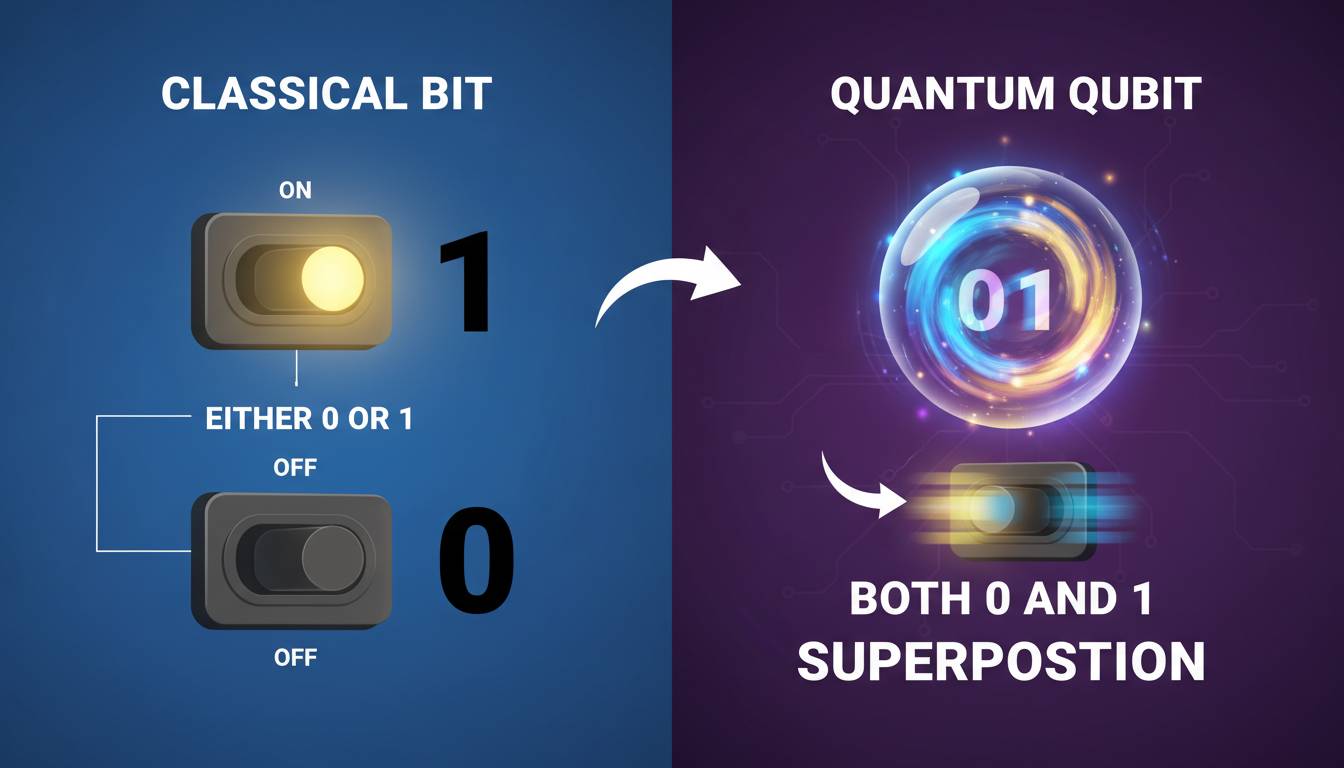
Quantum computing is a fundamentally different type of computation that uses the strange behaviors of subatomic particles to process information in ways that classical computers cannot. While classical computers store information as bits—each one either a 0 or a 1—quantum computers use quantum bits, or qubits, which can exist in multiple states simultaneously thanks to quantum mechanical properties.
Think of it like this: if classical computing is a light switch that can only be on or off, quantum computing is a dimmer switch that can be on, off, and every shade in between at the same time. This isn’t just a metaphor—it’s actually how particles behave at the quantum scale. The implications for computation are staggering, because it means quantum computers can explore many possible solutions simultaneously rather than checking them one by one.
The core difference: Classical vs. quantum computing
To understand why quantum computing matters, you need to understand what classical computers actually do. Every operation your laptop or smartphone performs—whether it’s rendering a video, running a spreadsheet, or generating this text—boils down to manipulating strings of 0s and 1s. Your processor has billions of transistors that switch between on (1) and off (0) states billions of times per second.
This approach works beautifully for most tasks. Classical computers excel at sequential operations, logical decisions, and precisely controlled calculations. But some problems are so computationally demanding that even the most powerful classical supercomputers would need billions of years to solve them—problems like simulating molecular interactions for new drug development, optimizing global logistics networks, or factoring impossibly large numbers.
Quantum computers don’t simply do the same thing faster. They approach problems using fundamentally different principles that make certain categories of problems tractable. IBM, Google, and other companies developing quantum hardware aren’t trying to replace your laptop—they’re building machines that can tackle problems that classical computers fundamentally cannot handle efficiently.
Understanding qubits: The building blocks of quantum computing
A classical bit is impossibly simple: it’s either 0 or 1, like a coin lying flat on a table showing either heads or tails. A qubit, by contrast, is more like a coin spinning in the air—while it’s spinning, it’s neither heads nor tails, but some combination of both.
Physically, qubits can be implemented in several ways. The most common approaches include:
- Superconducting circuits: Used by IBM and Google, these create qubit states using superconducting materials cooled to temperatures colder than outer space
- Trapped ions: These use individual atoms suspended in electromagnetic fields, manipulated with precisely tuned lasers
- Topological qubits: Microsoft’s approach, which uses quasi-particles with more stable quantum properties
The critical point isn’t the physical implementation—it’s what qubits enable. A single qubit can represent a 0, a 1, or any quantum superposition of both states. Two qubits can represent four states simultaneously. Three qubits can represent eight. The scaling is exponential: n qubits can represent 2ⁿ states at once.
This exponential scaling is where quantum computing’s power comes from. With just 50 qubits—modest by current standards—a quantum computer can represent more than one quadrillion (10¹⁵) states simultaneously. Reach a few hundred logical qubits, and you can represent more states than there are atoms in the observable universe.
What is superposition?
Superposition is the quantum property that allows particles to exist in multiple states simultaneously until measured. It’s the reason qubits can represent both 0 and 1 at the same time, and it’s the source of quantum computing’s computational advantage.
Here’s an analogy that helps: imagine you’re standing in a maze with a thousand possible paths, and you need to find the one that leads to the exit. A classical computer would systematically check each path one after another. A quantum computer, thanks to superposition, can effectively try all thousand paths simultaneously—though extracting the correct answer requires careful design of the quantum algorithm.
The catch is that superposition is incredibly fragile. Any interaction with the external environment—slight vibrations, temperature changes, electromagnetic radiation—can collapse the delicate quantum state into a mundane 0 or 1. This phenomenon, called decoherence, is why quantum computers operate at temperatures close to absolute zero and are shielded from nearly every possible environmental influence.
IBM’s quantum systems, for instance, operate at 15 millikelvin—about 180 times colder than interstellar space. The engineering required to maintain superposition for meaningful computation durations represents one of the most challenging problems in physics.
What is entanglement?
Entanglement is perhaps the most counterintuitive quantum phenomenon, and it’s also one of the most computationally valuable. When particles become entangled, measuring one instantly affects the other, regardless of the distance between them—even if they’re on opposite sides of the universe.
Einstein famously called this “spooky action at a distance” and spent years trying to disprove it. Decades of experiments have confirmed that entanglement is real, genuine, and not explainable by any hidden variables. Particles really do influence each other instantaneously across any distance.
In quantum computing, entanglement between qubits creates correlations that classical systems cannot replicate. When qubits are properly entangled, their combined quantum state cannot be described independently—they’re mathematically correlated in ways that enable powerful computational shortcuts.
Entanglement is what allows quantum algorithms to achieve exponential speedups for certain problems. Shor’s algorithm for factoring large numbers—which threatens current encryption systems—relies fundamentally on entangling qubits to exploit mathematical structures that classical algorithms cannot efficiently explore.
How does a quantum computer actually work?
Building a working quantum computer involves several distinct stages, each presenting enormous engineering challenges:
1. Initialization: The qubits must be prepared in a known starting state, typically all zeros. This involves precisely controlling the quantum system using electromagnetic fields, lasers, or other manipulation techniques depending on the hardware platform.
2. Quantum gates: Just as classical computers use logic gates (AND, OR, NOT) to manipulate bits, quantum computers use quantum gates that rotate the qubit states in quantum space. These operations exploit superposition and entanglement to perform computations. Google’s Sycamore processor, which achieved quantum supremacy in 2019, used a sequence of precisely timed microwave pulses acting as quantum gates on 53 superconducting qubits.
3. Measurement: After the quantum algorithm runs, the qubits must be measured. This collapses their quantum states into definite 0 or 1 values. Here’s the critical nuance: quantum mechanics is probabilistic. Run the same quantum computation multiple times, and you’ll get different results—the algorithm must be designed so that the correct answer appears with high probability while wrong answers are suppressed.
4. Error correction: Current quantum computers are incredibly noisy. The quantum states last only microseconds before decoherence scrambles them. Quantum error correction—a fascinating field in its own right—uses multiple physical qubits to encode a single logical qubit, adding redundancy that protects against errors but requires enormous hardware overhead.
The entire process from initialization through measurement might take microseconds to milliseconds. Compare that to classical computers, which can perform billions of operations per second for years without meaningful errors. Quantum computers are nowhere near that level of reliability, and that’s a fundamental challenge the field is actively working to solve.
Why does quantum computing matter?
The applications where quantum computers offer genuine advantages fall into several categories:
Simulation of quantum systems: This is arguably quantum computing’s most natural application. Because quantum computers operate using quantum mechanics, they’re exceptionally good at simulating other quantum systems. Pharmaceutical companies like Roche are investing heavily in quantum computing to simulate molecular interactions, potentially accelerating drug discovery by years. Materials science benefits similarly—designing better batteries, solar cells, and superconductors all involve understanding quantum-level interactions.
Optimization problems: Finding the best solution among countless possibilities is notoriously difficult for classical computers. Quantum algorithms like QAOA (Quantum Approximate Optimization Algorithm) and future fault-tolerant approaches could revolutionize supply chain logistics, financial portfolio optimization, and traffic flow management.
Cryptography: Shor’s algorithm can factor large numbers exponentially faster than any known classical algorithm, threatening the RSA encryption protecting most internet communications. This isn’t a future concern—organizations are already collecting encrypted data today in anticipation of quantum computers powerful enough to decrypt it later. Post-quantum cryptography standards are being developed now to replace current encryption methods.
Machine learning: Quantum machine learning algorithms potentially offer speedups for certain problem types, though the practical advantages over classical approaches remain an active research area. Google, IBM, and various startups are exploring hybrid quantum-classical approaches.
Current state of quantum computing: Reality check
I want to be honest with you about where quantum computing actually stands in early 2025. The field has made remarkable progress in hardware development, but we’re still far from the fault-tolerant quantum computers that could solve practical problems at scale.
Google claimed “quantum supremacy” in 2019 when their 53-qubit Sycamore processor completed a specific calculation in 200 seconds that they estimated would take classical supercomputers 10,000 years. IBM has since built larger systems, including processors with over 1,000 qubits. China has demonstrated impressive quantum computing milestones as well.
However, these machines still produce errors at rates that limit their usefulness. The qubits are so noisy that current systems are often described as being in the “Noisy Intermediate-Scale Quantum” (NISQ) era—powerful enough to demonstrate interesting physics but not powerful enough for most practical applications. Achieving fault-tolerant quantum computing capable of running Shor’s algorithm on cryptographically relevant numbers likely requires millions of physical qubits encoding thousands of logical qubits—an engineering challenge that may take a decade or more to solve.
This doesn’t mean quantum computing is overhyped. It means the timeline is longer than some enthusiastic predictions suggest, and the near-term applications will be more limited than the most optimistic marketing would imply.
Frequently asked questions
How fast is a quantum computer compared to a regular computer?
This question doesn’t have a simple answer because quantum computers aren’t faster for all tasks. For many everyday computations, classical computers remain superior. Quantum computers offer exponential speedups for specific problem types—factoring large numbers, searching unsorted databases, and simulating quantum systems—but may actually be slower for simple arithmetic or data storage. The speed advantage only appears for the right problems.
Will quantum computers replace classical computers?
Almost certainly not. Classical computers excel at tasks that quantum computers struggle with: precise sequential operations, storage, and most everyday computing tasks. The most likely future involves hybrid systems where classical computers handle what they’re good at and quantum co-processors handle specific computational bottlenecks. Your phone isn’t getting replaced by a quantum computer anytime soon.
Can quantum computers break passwords?
In theory, yes. Large enough quantum computers running Shor’s algorithm could break RSA encryption, which protects most internet communications. However, current quantum computers are nowhere near large enough or stable enough to do this. The more immediate concern is “harvest now, decrypt later” attacks where adversaries collect encrypted data today for future quantum decryption. This is why post-quantum cryptography is being developed and deployed now.
How close are we to practical quantum computers?
It depends on what you mean by “practical.” For optimization problems and simulations in specific domains, NISQ-era quantum computers already provide value in research settings, though their advantage over classical methods is often unclear. For cryptographically relevant applications or simulating complex molecules, we’re likely looking at 10-15 years or more of development before fault-tolerant systems become available.
Looking forward: The unresolved questions
Quantum computing stands at an inflection point where the fundamental physics is well understood but the engineering challenges remain immense. Whether we’ll achieve fault-tolerant quantum computing that delivers on the technology’s promise depends on continued breakthroughs in materials science, control electronics, error correction, and algorithm design.
What excites me most isn’t the deterministic applications—the drug discovery, the code-breaking—but the possibility of discovering something genuinely unexpected. Quantum mechanics has a history of surprising us, and quantum computers may reveal computational phenomena we haven’t imagined yet.
The question isn’t just when quantum computers will become practical, but what they’ll teach us about computation itself in the process.
