
The dream of building meaningful wealth through technology investments isn’t reserved for Silicon Valley insiders or finance professionals with Bloomberg terminals. I’ve watched regular investors—teachers, engineers, small business owners—build substantial portfolios by approaching tech investing with structure and discipline instead of chasing the latest hot stock on social media. The difference between those who succeed and those who get burned comes down to understanding what they’re actually buying, how much risk they’re genuinely comfortable with, and whether they’re willing to stay the course when the market inevitably wobbles.
This guide assumes you have some familiarity with how brokerage accounts work but want a systematic framework for building a technology-focused portfolio. I’m going to walk you through allocation strategy, specific investment vehicles, the real risks you’ll face, and the practical steps to execute your plan. No hype, no get-rich-quick promises—just a methodology that has worked for investors who treated this like building a business, not gambling.
Why Technology Deserves a Dedicated Spot in Your Portfolio
Technology has fundamentally changed how the entire global economy generates value. The ten largest companies by market capitalization in the S&P 500 as of early 2025 are mostly technology firms: Apple, Microsoft, NVIDIA, Alphabet, Amazon, Meta. These companies have created trillions in shareholder value over the past two decades. This isn’t a temporary trend; it’s a structural shift in how businesses operate and compete.
The compounding power of technology companies comes from high gross margins and network effects. A software company like Microsoft can serve additional customers with virtually zero marginal cost. NVIDIA’s GPU hardware becomes more valuable as more AI applications are built on top of its architecture. These dynamics create winner-take-most markets that traditional sectors simply cannot replicate. When you invest in well-managed technology companies, you’re betting on the continuation of these powerful economic moats.
Here’s where I need to push back against conventional wisdom, though. Many advisors recommend tech investing purely for growth and then lecture investors about diversification when tech underperforms. That’s backwards thinking. The real case for tech isn’t just higher returns—it’s that a technology allocation provides genuine diversification benefits because tech companies often move independently of traditional market forces. During periods of economic stress, however, this “independence” can flip to correlation. The point isn’t that tech is guaranteed to outperform. It’s that when properly allocated, tech provides return streams that behave differently from bonds, real estate, and consumer staples—which is the entire point of diversifying across sectors.
How Much Tech Allocation Is Right for You?
This is the question I get asked most often, and the honest answer is: it depends entirely on your timeline and risk tolerance. There’s no magic number that works for everyone, but I can give you a framework for thinking through it.
For most beginning investors, I recommend keeping technology exposure between 15% and 30% of your total portfolio. This range is wide enough to capture meaningful upside from the sector while preventing a tech crash from destroying your overall financial plan. If you’re 30 years old with a 30-year investment horizon and stable income, 25-30% in tech is reasonable. If you’re 50 years old and approaching retirement, 10-15% is probably more appropriate.
Let me explain why this range specifically. Below 10%, technology becomes a rounding error in your portfolio—you won’t meaningfully benefit from the sector’s growth. Above 30%, you’re essentially making a bet that technology will continue outperforming every other sector indefinitely, which history suggests is unlikely. The period from 2020 to early 2025 was exceptionally generous to tech investors. The period from 2000 to 2003 was devastating. Your allocation should survive both scenarios.
One more thing that most articles won’t tell you: your tech allocation should decrease as your portfolio grows. When you have $10,000, a 30% tech allocation means $3,000 invested in the sector—that’s enough to matter but small enough that you can add more during downturns. When you have $500,000, that same percentage means $150,000 in technology. At that size, the absolute dollar swings become emotionally difficult to stomach for many investors. I generally recommend that investors with portfolios exceeding $250,000 consider reducing tech allocations toward the 20% range—not because tech stops being a good investment, but because portfolio size changes the psychology of investing in ways that affect behavior.
Opening Your Brokerage Account – The First Practical Step
Before you can buy anything, you need a place to hold your investments. Choosing the right brokerage isn’t the most exciting part of building a portfolio, but it has real consequences for your returns over time.
For most investors building a tech-focused portfolio, I recommend starting with either Fidelity, Schwab, or Vanguard. All three offer commission-free trading for ETFs and stocks, provide excellent mobile and desktop platforms, and have strong customer service. The differences between them are minor for most investors. Vanguard edges slightly ahead if you want to build a portfolio primarily around low-cost index funds, while Schwab and Fidelity offer more intuitive interfaces for trading individual stocks.
If you’re specifically interested in fractional shares—which I highly recommend for anyone building a tech portfolio since most tech stocks are expensive—check that your broker supports this feature. Fidelity and Schwab both offer fractional trading on S&P 500 companies. Robinhood also offers fractional trading and appeals to younger investors with its simple interface, though I’ve seen concerns about their execution quality and customer service that give me pause for serious investors.
One practical consideration: if you’re building a taxable brokerage account, look for brokers that support automated dividend reinvestment (DRIP) and tax-loss harvesting. These features matter more for growth-focused portfolios like tech, where you’ll hold positions for years and want to optimize the tax efficiency of your dividends and rebalancing decisions.
The Best Tech ETFs for Building Your Foundation
Exchange-traded funds provide the most efficient way to build technology exposure without picking individual stocks. They offer instant diversification, low costs, and transparency about what you actually own. Here are the ETFs I return to most often when helping investors build tech allocations.
Invesco QQQ tracks the Nasdaq-100, which is heavily weighted toward technology. With an expense ratio of just 0.20%, it holds the world’s largest technology companies including Apple, Microsoft, NVIDIA, and Alphabet. The QQQ has a decades-long track record and represents the broadest tech-heavy index available. It’s my default recommendation for investors who want “technology” as a single position.
Vanguard Information Technology ETF (VGT) provides similar exposure through a Vanguard-managed fund with an even lower expense ratio of 0.10%. VGT holds around 350 companies across the technology sector, giving you more diversification than the QQQ’s 100 holdings while maintaining a pure tech focus. This is my choice for investors who want to own “all of technology” rather than just the largest names.
Technology Select Sector SPDR Fund (XLK) focuses even more narrowly on software, hardware, and semiconductor companies. With an expense ratio of 0.10%, XLK is the cheapest pure-play tech ETF available. It’s more concentrated than VGT, which means it will likely outperform during tech booms and underperform during busts. For investors who want to bet specifically on technology as a sector without exposure to other growth areas, this is the most direct vehicle.
ARK Innovation ETF (ARKK) represents the controversial “disruptive technology” approach. Managed by Cathie Wood, ARKK invests in companies expected to benefit from technological innovation across multiple sectors, not just traditional tech. This ETF is much more aggressive and volatile than the others I’ve mentioned. It lost approximately 70% of its value from peak to trough during 2022 before partially recovering. I include it here because some investors want this kind of high-conviction, growth-oriented exposure—but I want to be clear that this is a trading vehicle, not a core portfolio holding.
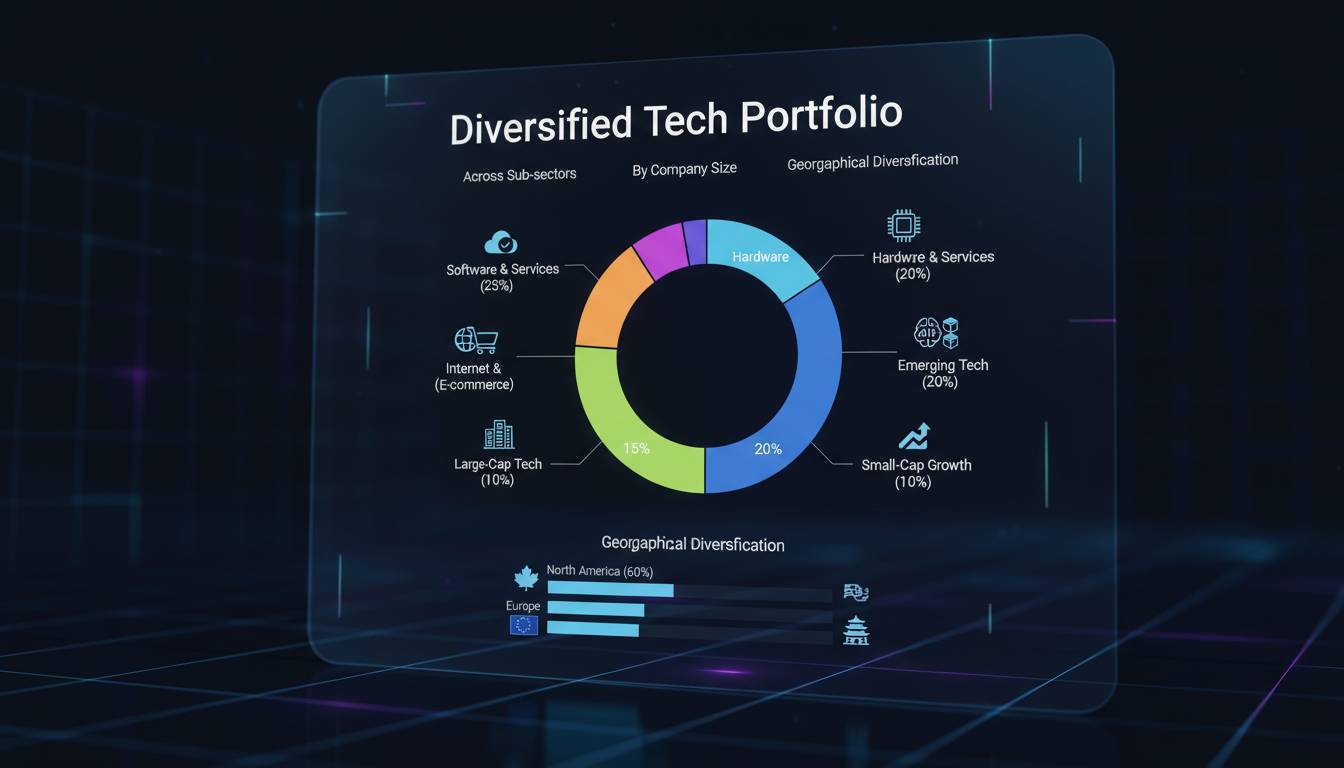
For most investors, I recommend building your tech allocation with 60-70% VGT or QQQ and 30-40% in individual stocks. This gives you broad sector exposure through the ETF while maintaining the ability to overweight specific companies you believe in.
Individual Tech Stocks Worth Considering
If you’re going to pick individual technology stocks, you need to understand what you’re buying. A stock isn’t just a ticker symbol—it’s ownership in a business with real revenue, competitors, and growth prospects. Here are the companies I consider core holdings for a tech-focused portfolio, along with why they merit inclusion.
Apple (AAPL) remains the world’s most valuable company for good reason. Its ecosystem lock-in through iPhone, Mac, Apple Watch, and services creates switching costs that competitors cannot easily replicate. The company generates over $100 billion in free cash flow annually, giving it resources to return capital to shareholders through dividends and buybacks while funding new product development. At roughly 30x earnings, Apple isn’t cheap—but you’re paying for stability and compounding.
Microsoft (MSFT) has transformed itself from a company people loved to hate into a cloud computing powerhouse. Azure is the second-largest cloud platform globally, and Microsoft Office remains the default productivity software for businesses worldwide. The company’s subscription model provides predictable revenue that has smoothed out the cyclicality that plagued older software companies. Microsoft deserves a place in virtually every tech portfolio.
NVIDIA (NVDA) has become the most important company in artificial intelligence infrastructure. Its GPUs power every major AI model training effort, and the company has effectively created a monopoly position in the highest-growth area of technology. The valuation is eye-watering—trading at over 60x earnings even after recent corrections—but if AI continues transforming industries, NVIDIA’s position suggests it will capture significant value.
Alphabet (GOOGL) owns Google, which remains the dominant search engine globally despite repeated attempts by competitors. Beyond search, YouTube, Google Cloud, and Android generate substantial revenue. The company is investing heavily in AI and has the balance sheet and talent to remain competitive as the technology evolves. At roughly 25x earnings, Alphabet is the cheapest of the mega-cap tech stocks.
Amazon (AMZN) is technically an e-commerce company but functions as a technology platform. AWS remains the dominant cloud infrastructure provider, generating billions in profit while e-commerce operates on thin margins. Amazon’s logistics network has become a competitive moat that would cost competitors tens of billions to replicate.
I’ll be honest: building a portfolio of individual tech stocks requires more ongoing attention than simply buying ETFs. You need to monitor earnings reports, understand competitive dynamics, and be willing to sell positions that stop making sense. For most investors, a portfolio of 5-8 individual stocks combined with an ETF for diversification is the right approach.
The Risk Reality Check Nobody Talks About
Technology investing carries risks that go beyond the obvious volatility. Understanding these risks is what separates sophisticated investors from those who get wiped out during inevitable downturns.
The first and most important risk is concentration. When you build a tech-focused portfolio, you’re betting heavily on a sector that can remain out of favor for extended periods. The 2000-2003 dot-com crash wiped out trillions in market capitalization. Many companies that seemed invincible—Cisco, Intel, Microsoft—lost 50-80% of their value and took years to recover. More recently, 2022 saw the worst year for tech stocks in over a decade, with the Nasdaq falling nearly 33%. If you can’t handle watching your portfolio lose a third of its value without panic-selling, you shouldn’t have a tech-focused allocation.
The second risk is valuation compression. Technology stocks often trade at premium valuations based on expectations of continued high growth. When interest rates rise—as they did dramatically in 2022—growth stocks become less attractive because their future profits are worth less in present value terms. This dynamic can hammer tech portfolios even when company fundamentals remain strong.
Third, individual company risk is real. Even the largest technology companies can underperform or decline. Research in Motion (RIM) dominated smartphones before Apple destroyed its market position. Yahoo was the internet’s gateway before Google surpassed it. No company is guaranteed to remain a market leader, and your portfolio needs diversification to manage this risk.
The counterintuitive point most articles won’t make: the biggest risk in tech investing isn’t a crash—it’s boring old inflation. Tech companies generally do well when inflation is low and interest rates are falling. When inflation persists and forces the Federal Reserve to keep rates elevated, tech stocks struggle. The 2022 selloff was driven primarily by rising interest rates, not by anything wrong with the underlying businesses. Understanding this helps you avoid panic selling when headlines scream about tech turmoil.
Dollar-Cost Averaging – Why Timing the Market Doesn’t Work
One of the most powerful tools for building a tech portfolio is dollar-cost averaging: investing a fixed amount at regular intervals regardless of whether prices are rising or falling. This strategy removes the impossible burden of predicting where prices will be next month or next year.
Here’s how it works in practice. Suppose you decide to invest $1,000 per month into your tech allocation. In month one, your $1,000 buys ten shares at $100 each. In month two, prices drop to $80—your $1,000 now buys 12.5 shares. In month three, prices recover to $120—you buy 8.3 shares. Over these three months, you’ve accumulated 30.8 shares at an average cost of approximately $97 per share, even though prices fluctuated significantly.
This approach is particularly powerful for volatile sectors like technology. You automatically buy more shares when prices are low and fewer when prices are high. Over time, this smooths out your entry point and reduces the emotional stress of watching daily price movements.
I recommend setting up automatic monthly investments rather than trying to time your entries based on market conditions. The data consistently shows that even professional investors struggle to time markets successfully. The individual investor’s advantage is time horizon and consistency, not market prediction.
One caveat: dollar-cost averaging works best when you have cash flow to invest over time. If you have a lump sum available—say from an inheritance or sale of an asset—you’re usually better off investing it immediately rather than spreading it out. Research by Vanguard found that lump sum investing beats dollar-cost averaging about two-thirds of the time, simply because markets tend to rise over time. Dollar-cost averaging is primarily for investors building positions gradually from ongoing income.
Tax-Efficient Strategies That Actually Matter
Taxes can consume a significant portion of your investment returns if you don’t manage them thoughtfully. For a tech-focused portfolio, several strategies deserve attention.
Account location is the foundation of tax-efficient investing. Hold your tax-advantaged accounts—401(k)s, IRAs, HSAs—for investments that generate ordinary income or frequent short-term capital gains. Hold investments that generate long-term capital gains in taxable accounts. Your tech ETFs and stocks, if held for more than a year, generate lower tax rates than bonds or REITs, making them better candidates for taxable accounts.
Tax-loss harvesting involves selling positions that have declined to realize losses that can offset gains elsewhere in your portfolio. In a volatile sector like technology, opportunities to harvest losses occur regularly. If your tech portfolio drops 20% during a market correction, you can sell positions to realize the loss, immediately buy a similar (but not identical) ETF, and maintain your market exposure while harvesting the tax benefit. Later, when prices recover, you’ve preserved the tax advantage.
The wash sale rule prevents you from buying the same security within 30 days before or after selling at a loss. This is where holding similar ETFs matters—you can sell VGT and buy XLK, for example, maintaining technology exposure while respecting the wash sale rule.
Qualified dividends from US technology companies are taxed at lower capital gains rates rather than ordinary income rates. This is a meaningful benefit that often gets overlooked. When you hold individual tech stocks in a taxable account, you’re benefiting from this preferential treatment automatically.
For most individual investors, these strategies matter more than trying to find exotic tax shelters. The combination of proper account placement and disciplined tax-loss harvesting can easily add 0.5% to 1% to your annual after-tax returns—compounded over decades, that’s a massive difference.
Common Mistakes That Will Cost You
I’ve watched investors undermine their own tech portfolios through predictable mistakes. Here’s how to avoid them.
Chasing performance is the most common killer. In 2023, artificial intelligence became the hot theme, and investors piled into AI stocks at valuations that had no connection to actual business fundamentals. Many of those same investors sold in early 2024 when the market rotated away from AI, locking in losses. The pattern is always the same: buy after impressive returns, sell after disappointing ones. You’re guaranteed to underperform if you buy what’s already gone up.
Ignoring valuation because “it’s a tech company” is a trap. Yes, technology companies often warrant premium valuations. But there’s a limit. When NVIDIA trades at 60x earnings and AMD trades at 200x, you’re making a bet that growth will exceed expectations by enormous margins. Sometimes that works. Often it doesn’t. At minimum, understand what P/E ratio you’re paying and compare it to historical ranges and growth rates.
Overconcentration in a single company catches inexperienced investors constantly. I once worked with an investor who had 40% of his portfolio in a single semiconductor stock because a friend who worked there told him the company was “going to the moon.” When that stock declined, his entire financial plan was compromised. No single position should exceed 5-10% of your portfolio, regardless of how confident you are in the company.
Neglecting rebalancing lets winners run until they become an outsized risk. If your tech allocation grows from 20% to 40% of your portfolio because tech outperformed, you need to rebalance back to your target. This feels counterintuitive—you’re selling winners to buy underperformers—but it’s how you manage risk. Without rebalancing, your portfolio slowly transforms into whatever performed best recently, which is exactly when it’s most likely to reverse.
Conclusion
Building a technology-focused investment portfolio from scratch requires more than enthusiasm for innovation. It demands a clear allocation strategy, appropriate investment vehicles, realistic understanding of risks, and the discipline to execute your plan when emotions tell you to do otherwise.
The framework in this guide—targeting 15-30% tech allocation, building a foundation with low-cost ETFs supplemented by individual stocks, practicing dollar-cost averaging, and managing tax efficiency—provides a structure that can work across different market environments. It won’t guarantee outperformance. Nothing guarantees outperformance. But it will give you a coherent approach that doesn’t require predicting which stock will be the next big thing.
Here’s what I don’t know: whether the next decade for technology investing will resemble the last one, with AI driving extraordinary returns, or whether we’ll see a prolonged period of consolidation and lower valuations as the sector digests its gains. What I do know is that investors who approach this systematically will be better positioned to respond to either scenario than those chasing headlines.
Start with your allocation target, open your brokerage account, and begin building your positions. The best time to start was years ago. The second-best time is now.
