
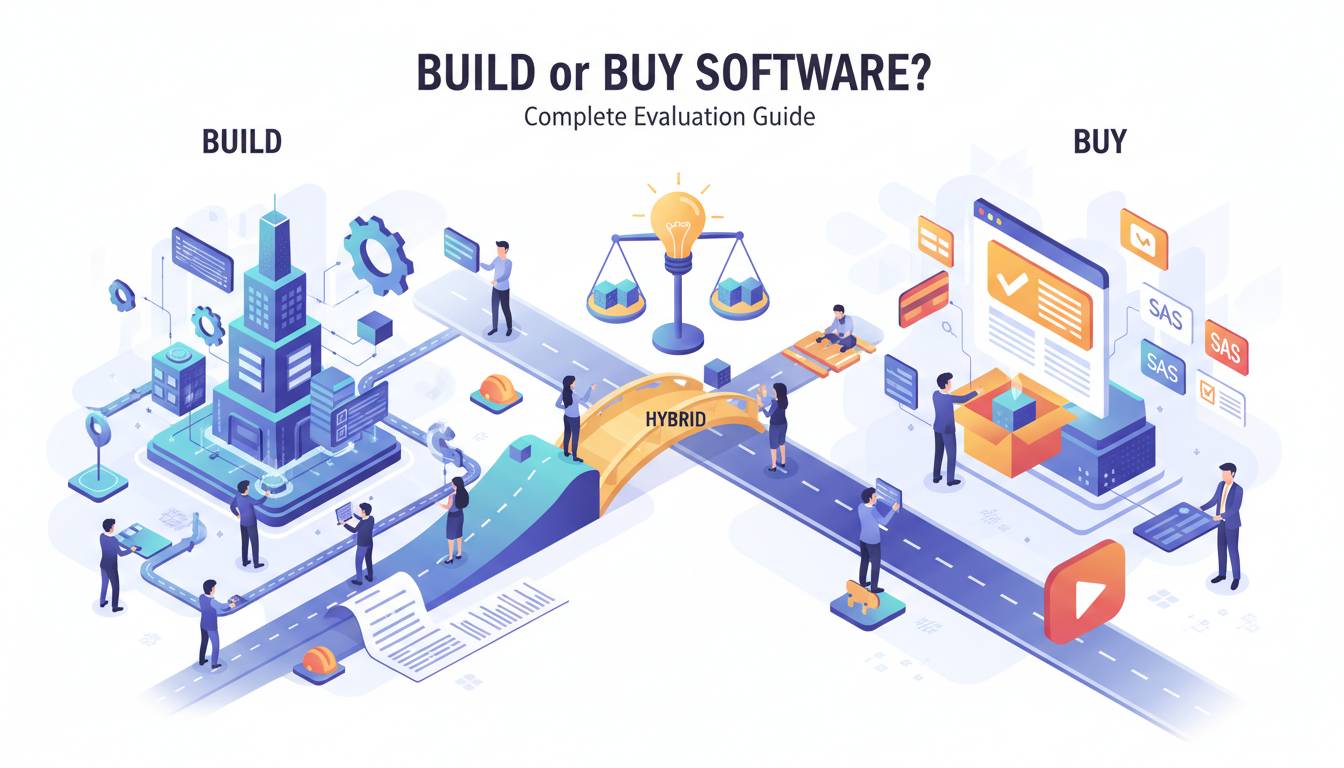
The software decision you make today will either accelerate your business for years or saddle you with technical debt that eats engineering time well into the next decade. I’ve watched companies burn through millions building internally what they could’ve bought for a fraction of the cost—and I’ve seen others get locked into vendor contracts that gave them less flexibility than they’d have had building from scratch. The difference between those outcomes often comes down to one thing: whether leadership actually did the hard evaluation work upfront, or just followed gut instinct and confirmation bias.
This guide gives you a rigorous framework for making the build versus buy decision. I’m not going to pretend there’s a simple formula—too many contextual factors matter. But I will walk you through the specific criteria that separate good decisions from expensive mistakes, with real examples from companies who’ve walked this path. You’ll find a practical checklist at the end, but use it as a starting point for deeper analysis, not a replacement for it.
The Five Factors That Actually Matter
Every framework out there tries to distill this decision into a neat list, and most of them get it roughly right but miss the nuances that determine outcomes in practice. After reviewing analyst frameworks from Gartner, discussions at Harvard Business Review, and patterns from enterprise software implementations, five factors consistently emerge as the primary drivers of build versus buy success:
Total Cost of Ownership (TCO) is where most analysis begins and where most analysis fails. People look at the sticker price of commercial software versus the estimated development cost and declare a winner. That’s naïve. TCO includes implementation, integration, training, ongoing maintenance, upgrade costs, and—critically—the opportunity cost of what your engineering team could be building instead. A $50,000 annual SaaS subscription might look expensive until you factor in that building the equivalent in-house would require three senior engineers for 18 months, plus ongoing maintenance, plus the integration work.
Time to Value matters more than most executives realize. Commercial software that does 80% of what you need can be deployed in weeks. A custom build that does 100% of what you need might take 12 to 24 months to reach parity with existing market solutions—and that’s before you factor in the learning curve of maintaining something your team hasn’t built before. If speed to market or speed to capability is competitive differentiator, this factor alone can settle the debate.
Customization Requirements create a false sense of security for buyers. The argument goes: “We have unique processes, so we need to build.” But most “unique” processes aren’t actually that unique, and commercial software has gotten far more configurable than it was five years ago. The real question is whether your differentiation depends on capabilities that are core to what you’re buying, or whether you’re just annoyed that the software doesn’t match your current workflow—which will likely evolve anyway.
Integration Complexity is the factor I see underestimated most frequently. Buying software means connecting it to your existing systems—CRM, ERP, data warehouse, identity management, analytics stack. Each integration is a maintenance burden, a potential failure point, and a source of data inconsistency. Building everything internally can actually reduce integration burden if you’re willing to accept a unified architecture from the start. But if you already have a tangled mess of systems, adding commercial software on top creates its own challenges.
Maintenance and Support is the long-term consideration that kills more build decisions than anything else. The day you ship version one is the day you become the vendor for that software. You’ll need to fix bugs, patch security vulnerabilities, add features to keep pace with competitors, and support users who have questions. This ongoing burden is often invisible in initial cost calculations but becomes crushingly obvious three years in, when the original builders have moved on and institutional knowledge has evaporated.
When Building Your Own Software Actually Makes Sense
The conventional wisdom in tech circles has swung hard toward “buy over build” in recent years, driven by the proliferation of excellent SaaS products and the rising cost of engineering talent. That’s generally sound advice, but it’s become orthodoxy—and orthodoxy blinds people to legitimate build scenarios. Let me be specific about when building makes genuine sense.
When software is your core differentiator, building becomes not just acceptable but strategically necessary. Stripe didn’t become a $95 billion company by buying payment processing software. They built it, because payment infrastructure is what they sell. The same logic applies to any company where software is the product, not just an operational tool. If your competitive advantage depends on capabilities that no vendor offers and no vendor will build specifically for your market, you’re not building a commodity—you’re building a differentiator.
When you need deep, systemic integration that commercial vendors can’t or won’t support, custom development becomes pragmatic. I’ve seen healthcare companies try to force commercial EHR systems into data architectures that required contortions that made both systems less functional. When your software needs to touch core business data in ways that vendors won’t allow access to, or when regulatory requirements demand audit trails that packaged software can’t provide, the build path becomes the only viable path.
When you have unusual scale or performance requirements that fall outside what commercial software is designed to handle, custom solutions can outperform. Most SaaS products are built for the 80th percentile use case—not the extreme edge cases that certain businesses face. If your data volumes, latency requirements, or processing complexity exceeds what vendors optimize for, you’ll spend more time fighting software designed for different constraints than you would building for your actual needs.
When you have engineering capacity that would otherwise be underutilized and the software need is relatively bounded, internal tools development can make sense—but only under specific conditions. The key is honest assessment: do you actually have engineers with bandwidth, or are you borrowing from product work that’s more important? Is the software scope contained enough to be maintainable, or will it grow into a sprawling system that absorbs engineering resources forever? Companies with strong engineering cultures sometimes underestimate how much overhead custom software creates, while those with weaker engineering cultures often overestimate their ability to build anything reliably.
When Buying Commercial Software Is the Clear Winner
For all the scenarios where building makes sense, there are far more situations where buying is unambiguously correct—and I wish more executives recognized this earlier, before they’d spent two years and $2 million on a custom solution that a $100,000 annual license would’ve handled better.
When the problem is well-understood and common, commercial software has had years to refine the solution you’re trying to reinvent. CRM, HRIS, expense management, project tracking, help desk software—these categories have mature products from vendors who’ve solved edge cases you haven’t even encountered yet. When Gartner or Forrester categorizes something as a “mature market,” that signals that commercial offerings have consolidated around best practices. Building in these categories is rarely competitive advantage—it’s just engineering arrogance dressed up as differentiation.
When you lack engineering resources to build and maintain the software long-term, buying is the only responsible choice. This seems obvious, but I cannot count the times I’ve seen companies start custom builds without any honest conversation about who will maintain it. The original developers move on. Knowledge walks out the door. Maintenance falls to whoever’s available, who then treats the system as a burden rather than a priority. If your engineering team is already stretched thin on core product work, adding infrastructure software to their plate is a recipe for burnout and attrition.
When speed is more important than perfection, buying wins every time. A commercial product that’s 70% perfect and deployable in two weeks beats a custom build that’s 95% perfect but ships in 18 months. The math changes when you factor in opportunity cost—which is almost always ignored in build versus buy analysis. That two months of delay might mean entering a market before competitors, or capturing revenue that the current manual process is leaking.
When your requirements are likely to change, commercial software’s configurability becomes an asset rather than a limitation. Most companies’ needs evolve faster than they expect, and the “we’ll just build it to match our exact current process” argument ignores how quickly that process will change. Vendor software forces some discipline in your processes, which is often a feature, not a bug. Custom software lets you codify whatever current mess you’re in, which becomes technical debt before the first release.
How to Calculate Total Cost of Ownership Honestly
Most TCO analysis fails because it treats the future as if it will resemble the present. The spreadsheet looks reasonable in year one and becomes absurd by year three. Here’s how to do it right, based on frameworks I’ve seen work at companies that didn’t get burned.
Start with direct costs: licensing or subscription fees for commercial software, versus development costs (salaries, tools, infrastructure) for custom builds. Development costs should include not just initial build but the full team—project managers, designers, QA, DevOps—not just engineers writing code. A common mistake is estimating “three engineers for twelve months” without accounting for the supporting roles that determine whether the project succeeds.
Add integration costs. Every system you connect adds complexity. Estimate integration development time conservatively—it’s almost always worse than you think. For commercial software, assume each meaningful integration takes two to four weeks of implementation work. For custom builds, integration is theoretically simpler but depends on API quality from other systems you’re connecting to.
Factor in training and change management. Commercial software comes with training resources and community support. Custom software requires you to build all documentation and training from scratch, plus deal with internal resistance to new systems. Budget at least 20% of implementation cost for getting people to actually use the thing.
Now the part everyone underweights: ongoing maintenance. For commercial software, this is typically the annual license cost, which usually increases 10-15% per year. For custom software, maintenance typically consumes 15-25% of original development cost annually—patching security vulnerabilities, fixing bugs, adding small features, updating for API changes in systems you integrate with. After three years, you’ve likely spent more on maintenance than you did on the original build.
Finally, calculate opportunity cost. What would your engineering team build if they weren’t building this? If they’re diverted from core product work, that’s revenue you’re not capturing. If they’re building infrastructure that a vendor would provide cheaper, that’s money left on the table. This is the hardest cost to quantify but often the most important.
The Hidden Costs Nobody Talks About
Beyond the standard TCO framework, there are costs that are real but rarely captured in any spreadsheet—and understanding them separates experienced decision-makers from novices who think this is purely a math problem.
Vendor lock-in is frequently cited as a reason to build, but it’s more nuanced than that. Some vendors make migration extremely difficult through data formats, API limitations, or contract terms. However, building yourself creates a different kind of lock-in: you’re locked into your own choices, with no vendor to blame when things go wrong. I’ve seen companies trapped in custom systems that were technically “their own” but which had become unusable liabilities that nobody wanted to maintain.
Organizational learning is an underappreciated factor. Building software teaches your team things they couldn’t learn any other way. The process of solving hard technical problems creates institutional knowledge, develops engineering capability, and surfaces talent. Buying software teaches you how to configure and use software—which is valuable but doesn’t build the same kind of technical muscle. For companies trying to develop engineering culture, this argument can cut either way depending on what you’re optimizing for.
Technical debt from quick buying is real but differently distributed. When you buy commercial software, you’re inheriting someone else’s architecture decisions, which might not match how your team thinks about systems. You work around vendor limitations, which creates process debt. When you build, you own the debt but at least understand it. Neither option is debt-free—you’re just choosing which kind of debt you’re willing to carry.
Making the Decision: A Practical Framework
Rather than a simple binary, think of this as a spectrum. At one extreme are scenarios where buying is clearly correct—commodity functions, well-understood problems, limited engineering resources. At the other extreme are scenarios where building is clearly correct—core differentiators, unique constraints, strategic necessity. Most decisions fall in the messy middle, and that’s where the real work happens.
Use this sequential filter to work through your decision:
First, ask whether this is core to your competitive advantage. If the software directly affects how you win customers or deliver value, lean toward building—assuming you have the resources to do it well. If it’s operational infrastructure that enables your business but doesn’t define it, lean toward buying.
Second, assess your engineering capacity honestly. Not aspirational capacity—what your org chart says you have—but realistic capacity, accounting for attrition, competing priorities, and the fact that your best engineers probably have their own ideas about what they want to build. If you don’t have three to five engineers who genuinely want to own this system for the next three years, building becomes an act of optimism that history rarely rewards.
Third, evaluate timeline requirements. If you need capability in under six months, commercial software is almost always the answer. Custom builds can be fast for small, contained systems, but anything with meaningful complexity takes 12 to 24 months to mature.
Fourth, consider the maintenance burden you can actually sustain. Ask yourself: in three years, who will fix the security vulnerability in this system at 2 AM? If you don’t have a credible answer, don’t build.
Real-World Examples Worth Studying
Companies make this decision wrong in predictable ways, and looking at specific cases illuminates the principles better than any framework.
Salesforce famously built their own CRM in the early 2000s because nothing on the market could handle what they needed. That was a build decision that made sense because software was their product. But the same company has aggressively bought rather than built in adjacent categories—acquiring Tableau for analytics, MuleSoft for integration, Slack for collaboration—recognizing that those capabilities weren’t differentiators worth building.
Amazon, despite having enormous engineering resources, buys rather than builds for most internal needs. Their philosophy, articulated by Andy Jassy before he became CEO, is that engineers should focus on customer-facing innovation, not reinventing infrastructure that others do better. They build when latency, cost, or customization requirements demand it, but they’re ruthless about buying commodity capabilities.
Conversely, Netflix has built significant portions of their streaming infrastructure rather than buying—particularly around content delivery and recommendation systems. These are areas where their scale and requirements exceed what commercial vendors can provide, and where the technical capability directly affects competitive position.
The pattern across successful companies isn’t dogmatism about build or buy. It’s clear-eyed assessment of what’s strategic versus commodity, honest accounting of engineering capacity, and willingness to change the answer as conditions evolve.
Evaluation Checklist
Use this checklist to pressure-test your build versus buy decision. For each question, answer honestly—even one significant “no” should give you pause.
- [ ] Differentiation test: Does this software create measurable competitive advantage? If a competitor could use the same commercial product and beat you, this isn’t a build scenario.
- [ ] Resource test: Do we have (or can we hire) a team of three-plus engineers who will own this for the next three years? Not “can we staff it” but “do we have people who actually want this work.”
- [ ] Timeline test: Can we accept 12+ months to get to parity with existing market solutions? If speed matters more than perfection, buy.
- [ ] Maintenance test: Do we have a plan for ongoing support, security patching, and feature development? Who owns this in year three?
- [ ] TCO test: Have we calculated full costs including integration, training, and three years of maintenance? Is the build option at least 30% cheaper on TCO to justify the execution risk?
- [ ] Opportunity cost test: What would our best engineers build instead? Is that more valuable than this project?
- [ ] Uniqueness test: Are our requirements genuinely unique, or do they just feel unique because we haven’t researched what’s available? Have we talked to three vendors about their roadmap?
If you can honestly answer yes to all of these, building is defensible. If you’re uncertain on more than two, buying is the more conservative choice—and conservatism is often wisdom in software decisions.
Where This Gets Complicated
I want to be honest about the limits of any framework: the factors I’ve outlined here assume relatively stable market conditions and clear visibility into your own requirements. In practice, both of those assumptions often fail. Markets shift—software categories that seemed mature can be disrupted by new entrants or technological change. Your requirements evolve—features you thought were essential become less important as you learn more about actual user needs.
The most successful companies treat build versus buy not as a one-time decision but as a portfolio view that evolves over time. They might buy today and build later (when requirements clarify), or build today and buy later (when a vendor catches up). The key is avoiding the commitment that becomes a trap—either the vendor contract that locks you into mediocre functionality, or the custom system that becomes a maintenance quagmire.
What I can say with confidence: the companies that make this decision well aren’t the ones who follow a checklist blindly. They’re the ones who argue about it seriously—who challenge each other’s assumptions, who do the TCO math honestly, who ask the hard questions about who will maintain this in three years. The framework helps you ask the right questions. The judgment comes from your specific context, your specific team, and your specific bets about the future.
