
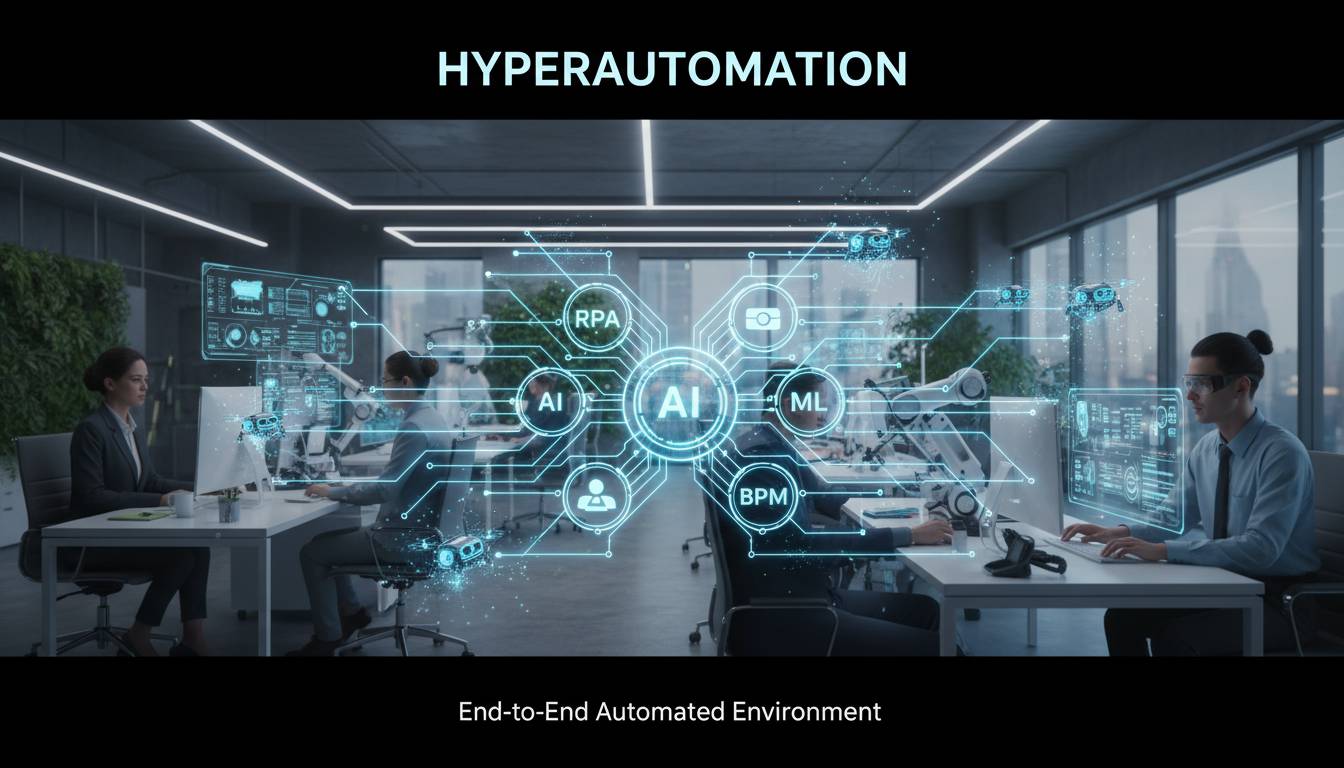
The conversation about workplace automation has shifted. Five years ago, executives could treat it as a distant theoretical concern — something that would arrive eventually, maybe in the next decade. Today, the question is no longer whether automation will reshape the workforce, but how quickly and what that transformation will mean for their specific business. The enterprises thriving right now aren’t waiting for certainty. They’re building workforce strategies around automation as an inevitability and figuring out the details as they go.
This isn’t theoretical. The World Economic Forum’s 2023 Future of Jobs Report projected that 23% of all jobs globally will undergo structural changes by 2027, with 83 million jobs displaced but 69 million new jobs created — a net transformation rather than a simple reduction. The organizations navigating this shift successfully treat it as an ongoing strategic planning exercise, not a one-time technology implementation. Here’s what business leaders need to understand about where workforce automation stands in early 2025 and where it’s heading.
The Acceleration Is Real — But Uneven
Automation adoption isn’t a single wave hitting all industries at once. It’s more like a tide that’s already submerged some sectors while others are still feeling the early pull. According to McKinsey’s 2024 Global Survey on automation, 55% of organizations have adopted AI in at least one business function, up from 50% in 2023 and just 20% in 2017. But within that aggregate number, manufacturing and financial services have moved dramatically faster than healthcare or construction.
Deloitte’s 2024 Automation Benchmarking Report found that high-performing organizations — those seeing at least 20% cost savings from automation — have deployed an average of 53 software robots per 1,000 employees, compared to just 8 among laggards. The gap isn’t shrinking. It’s widening. What this means for businesses is that the cost of not automating is becoming increasingly visible: competitors who move faster are capturing efficiency gains that compound quarter over quarter.
The practical takeaway is straightforward. If you’re in an industry where peers have already scaled automation, you’re not early anymore — you’re behind. If you’re in an industry where adoption is still nascent, the next eighteen months represent a window to build competitive advantage rather than catch up. Either way, the question has shifted from “should we automate” to “how do we automate at the right pace for our industry and workforce?”
The Job Displacement Narrative Is Incomplete
Every media headline about automation emphasizes job loss, and there’s legitimate cause for concern. Goldman Sachs estimated in a 2023 report that AI could automate roughly 25% of current work tasks in the US and EU, affecting approximately 300 million jobs globally. But framing this entirely as a subtraction problem obscures what’s actually happening in the data.
The World Economic Forum’s 2024 Employment Outlook found that while 92 million jobs are projected to be displaced across the global economy by 2030, 170 million new roles are expected to emerge — a net gain of 78 million jobs. The jobs being created aren’t just different from the ones being lost; they’re often in entirely different occupational categories. The decline of routine manufacturing work in the Midwest created space for healthcare support roles, IT services, and renewable energy positions that didn’t exist twenty years ago.
The businesses getting this right aren’t just cutting headcount to automation budgets. They’re redesigning their workforce composition entirely. AT&T’s 2023 workforce transformation program retrained over 100,000 employees for new technical roles, investing over $1 billion in education and skills development. The company’s internal data showed that employees who completed retraining programs had a 90% retention rate into new positions — far higher than industry averages for displaced workers. This isn’t charity. It’s strategic workforce planning that treats existing employees as assets to be redeployed, not costs to be eliminated.
The uncomfortable truth is that some jobs genuinely will disappear without a clear replacement path — particularly in data entry, basic accounting, and certain logistics roles. Businesses that acknowledge this honestly and invest in transition support will retain institutional knowledge and workforce loyalty that competitors burnishing their automation credentials will struggle to rebuild.
Three Categories of Impact Worth Understanding
When executives ask what automation will do to their workforce, it helps to break the impact into three distinct categories rather than treating it as a single phenomenon.
Productivity augmentation is the most common and least disruptive form. This is automation handling routine, repetitive tasks while humans focus on judgment-heavy work. Call centers exemplify this shift: interactive voice response systems handle basic inquiries, but agents manage complex complaints that require emotional intelligence. Gartner predicted that by 2025, 70% of customer service interactions would involve some form of AI augmentation, but human agents would still manage 85% of emotionally complex conversations. This isn’t replacing workers — it’s changing what their workday looks like.
Process automation is more transformative. When a company deploys robotic process automation to handle invoice processing, inventory management, or compliance reporting, entire workflow categories disappear. UiPath, a leading RPA platform, reported in 2024 that their enterprise clients had automated an average of 35% of their finance and accounting workflows. The workers displaced aren’t necessarily fired — many are redeployed to analytical work that requires contextual judgment. But the headcount needed for those functions drops significantly.
Role elimination is the rarest and most contentious category. This is when automation genuinely renders a job category obsolete. Postal workers face this reality as mail volume declines. Retail cashiers are experiencing it as self-checkout and mobile POS systems reduce the need for human checkouts. Bank tellers have seen their role fundamentally transform over the past fifteen years, with branch visits declining 40% since 2010 while mobile banking transactions increased fifteenfold.
Understanding which category your automation investments fall into matters enormously for workforce planning. Augmentation and process automation can be managed through retraining and redeployment. Role elimination requires more honest conversations about what skills will be needed and whether existing employees can realistically acquire them.
The Skills Gap Is Widening Faster Than Most Assume
There’s a paradox in current workforce automation: companies are investing heavily in automation technology but struggling to find people who can implement and maintain it. LinkedIn’s 2024 Workforce Learning Report found that the fastest-growing job skills in the United States were almost entirely technology-related — cloud computing, AI model training, data engineering, cybersecurity — while demand for skills like manual data processing and basic programming declined.
The skills gap isn’t just at the technical level. As routine cognitive work gets automated, the premium on human-specific capabilities has increased dramatically. The World Economic Forum’s 2023 report identified analytical thinking, creative problem-solving, emotional intelligence, and leadership as the skills most likely to grow in value through 2025 and beyond. These aren’t skills that can be coded into software — they’re inherently human and increasingly scarce.
Businesses are responding, but not quickly enough. Only 33% of L&D professionals reported in a 2024 Association for Talent Development survey that their organizations had adequate programs to address automation-related skill shifts. The rest were either underinvesting, planning to address it later, or hoping the problem would resolve itself. That’s a gamble. When automation tools fail — and they do fail — you need people who can diagnose, adapt, and improvise. That requires skills that take months or years to develop, not days.
Amazon’s Career Choice program pre-pays 95% of tuition for employees pursuing in-demand fields, regardless of whether those skills are relevant to Amazon. The company has spent over $1.2 billion on this initiative since 2012, with more than 50,000 employees participating. Critics note this is partly a PR play, but it also reflects a genuine business reality: the companies that figure out how to build internal talent pipelines will have structural advantages over those relying on external hiring in a constrained labor market.
Human Skills Are Becoming the Differentiator
Here’s the counterintuitive part that many automation discussions miss: as AI and robotics get better at cognitive and manual tasks, the human skills that remain valuable are becoming less about task execution and more about relationship management, creative synthesis, and ethical judgment.
Consider what automation actually struggles with. It can analyze millions of financial transactions to detect fraud patterns, but it can’t negotiate a merger with a nervous founder who needs reassurance. It can generate marketing copy, but it can’t build a trusted relationship with a key client over years of dinners and crises. It can optimize a supply chain, but it can’t make the judgment call about whether to prioritize a long-term partner during a shortage when a short-term alternative would be cheaper.
McKinsey’s 2024 research on AI adoption found that the organizations seeing the highest returns weren’t those with the most sophisticated AI systems — they were the ones that had deliberately designed workflows where human judgment and AI processing complemented each other. In healthcare, AI-assisted diagnosis tools were most effective when they presented options to human physicians rather than making autonomous recommendations. In legal services, AI document review was most accurate when lawyers reviewed the edge cases the AI flagged as uncertain rather than accepting the tool’s outputs uncritically.
This has implications for how businesses should think about hiring and development. The premium is shifting toward workers who can collaborate effectively with automated systems — who know when to trust the algorithm and when to override it based on context the algorithm can’t see. These hybrid roles are where the highest-value employment is concentrating, and they’re the hardest roles to fill.
Retraining Programs Have a Terrible Track Record — But Some Work
I want to be honest about something: most corporate retraining programs fail. A 2023 Harvard Business School study of over 30,000 workers found that only 12% of employees who completed employer-funded retraining programs ended up in new roles that used the skills they learned. The rest either returned to their previous positions, left the company, or saw their new skills become irrelevant within two years.
The reasons are systemic. Most retraining programs are too short — a few days or weeks of classroom training that can’t build genuine capability in complex technical fields. They’re often mandatory, which creates resistance rather than motivation. And they frequently teach skills that are already becoming obsolete by the time employees complete the training, because the technology landscape shifts faster than curriculum development cycles.
But some programs work remarkably well. Siemens’ apprenticeship model, which combines on-the-job training with classroom instruction over three to four years, has produced workers with some of the lowest turnover and highest productivity metrics in German manufacturing. Germany’s dual-system apprenticeship approach generally — combining vocational education with practical workplace experience — has kept youth unemployment significantly below the European average despite significant automation pressure on entry-level positions.
What distinguishes successful programs is immersion, relevance, and worker agency. AT&T’s retraining initiative worked because it was voluntary, because employees could choose fields that interested them, and because the company committed to hiring from its own talent pool before looking externally. The programs that treat retraining as a checkbox exercise — send people to a two-week course, check the box, move on — are wasting money and destroying trust.
The Cost-Benefit Calculation Is More Complex Than It Appears
Business cases for automation typically focus on labor cost savings: replace a $50,000-a-year worker with a $15,000 annual software license, save $35,000 per year, calculate payback period. This framing is why automation initiatives often face resistance and why many fail to deliver projected returns.
The real economics are messier. Automation implementations require significant upfront investment in technology, integration, change management, and ongoing maintenance. Deloitte’s research found that the total cost of an automation implementation typically runs 1.5 to 3 times initial software licensing costs when you factor in integration, training, and process redesign. Payback periods that look attractive in spreadsheets often extend to three or four years in practice.
But the bigger issue is that the cost-benefit analysis ignores value creation, not just cost reduction. A customer service AI that handles 40% of inquiries doesn’t just save on agent hours — it improves response times, increases customer satisfaction scores, and frees agents to handle complex issues that drive retention. These indirect benefits are harder to quantify but often exceed the direct savings.
The most sophisticated automation investments treat cost reduction as a floor, not a ceiling. They’re looking for ways automation enables new business models, improves quality, accelerates cycle times, and creates customer experiences that weren’t possible before. A logistics company that automates route optimization isn’t just saving fuel — it’s offering customers faster delivery windows that competitors can’t match. That’s a revenue driver, not just a cost center.
What Responsible Automation Actually Looks Like
There’s a version of automation implementation that’s purely transactional: identify tasks that can be automated, replace the humans doing those tasks, capture the efficiency gains, move on. This approach is legally defensible and sometimes financially rational. It’s also increasingly shortsighted.
The companies building sustainable competitive advantages through automation are taking a broader view. They’re thinking about workforce transition as a strategic priority, not an HR problem to delegate. They’re involving workers in the design of automated systems, not just announcing those systems after they’re built. They’re being transparent about what automation means for career paths, even when that transparency is uncomfortable.
One example: Siemens implemented a “technology agreement” with its German workforce that guaranteed minimum employment levels during automation transitions, established mandatory retraining programs, and created internal mobility pipelines that allowed workers to move into new roles before positions were eliminated. The company spent more on this transition support than a pure cost-cutting approach would have required. But its workforce engagement scores improved, retention of experienced workers increased, and the automation implementations themselves went more smoothly because workers had been involved in the design process.
This isn’t purely altruistic. When automation implementations fail, it’s often because workers who understand existing processes intimately weren’t consulted during design, so the automated systems replicate the wrong workflows or miss edge cases that only experienced operators would recognize. The cost of this failure — in rework, in customer complaints, in abandoned implementations — often exceeds what the transition support would have cost in the first place.
The Timeline Has Compressed — What Worked Two Years Ago May Already Be Behind
If you’re reading this and thinking you have time to develop a thoughtful automation strategy, consider this: the technology available to businesses today is dramatically more capable than what existed in 2022, and the pace of improvement is accelerating. Large language models that could barely string coherent sentences together in 2022 can now pass bar exams, write functional code, and assist with complex analysis. Computer vision systems that required controlled environments two years ago now work reliably in variable lighting and weather conditions.
The strategic implications are stark. The automation roadmap you might have drawn up in 2023 assuming linear progress is already obsolete. Systems that were planned for 2026 implementation are becoming technically feasible today. This compression means businesses can’t afford to plan in five-year horizons anymore — they need to think in eighteen-month cycles and be willing to adapt quickly.
It also means that workforce planning has to be continuous rather than periodic. The annual workforce planning exercise that might have sufficed a decade ago can’t keep pace with these changes. Companies need to monitor technology developments, industry adoption patterns, and skill market dynamics on an ongoing basis, adjusting their workforce strategies as conditions evolve.
Where This Leaves Businesses
The organizations that will thrive through this transition aren’t the ones with the most aggressive automation strategies or the most cautious ones. They’re the ones that treat workforce automation as an ongoing strategic challenge rather than a one-time technology decision — the ones investing in their people’s ability to adapt alongside the technology, the ones building cultures that can absorb technological change without losing institutional knowledge and employee trust.
The hard truth is that every business will need to make difficult choices about which roles evolve, which transform, and which disappear. There is no fully comfortable path through this transition. But the businesses that pretend the choice isn’t coming will find themselves with workforces that are neither equipped for the new environment nor loyal to an organization that didn’t prepare them for it.
The next eighteen months will separate the organizations that treated automation as a strategic imperative from those that treated it as an IT project. The gap between leaders and laggards will continue to widen. The only question is which side of that gap your business will be on.
