
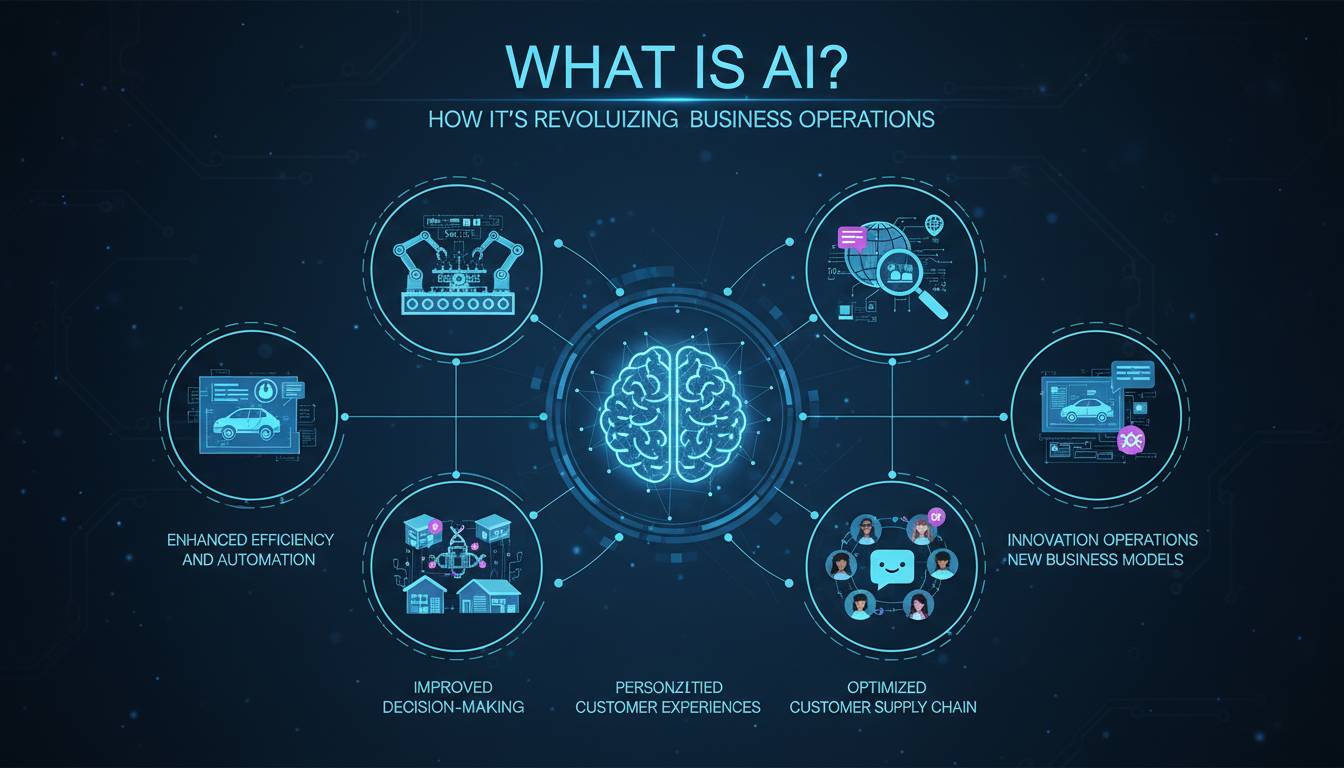
The conversation about artificial intelligence in business has shifted dramatically. Just two years ago, most executives treated AI as an experimental technology — something to pilot in a corner of the organization and evaluate. Today, the question is no longer whether to adopt AI but how fast you can integrate it across every function. This isn’t hyperbole. The enterprises that treated AI as optional are now watching competitors pull ahead in customer experience, operational efficiency, and decision-making speed. Understanding what AI actually is — and more importantly, what it does — is no longer optional for anyone in a leadership role. It’s foundational.
This guide covers what AI is, how it works, the specific ways it’s reshaping business operations, and the honest challenges that come with implementation. I’ve avoided the temptation to write a pure optimism piece. AI is transformative, but it’s also messy, expensive, and ethically complicated. You’ll get both sides.
What Is Artificial Intelligence?
Artificial intelligence refers to computer systems designed to perform tasks that historically required human intelligence. These tasks include reasoning, learning from experience, recognizing patterns, understanding language, and making decisions. The key distinction is that AI systems don’t just follow explicit programming instructions — they improve their performance over time through exposure to data.
The field dates back to the 1950s, but modern AI owes its current capabilities to three converging forces: massive increases in computing power, the availability of enormous datasets, and breakthrough algorithms, particularly deep learning models that emerged in the 2010s. Machine learning, a subset of AI, involves training systems on data so they can identify patterns without being explicitly programmed for every scenario. Deep learning goes further, using artificial neural networks inspired by the human brain to handle highly complex tasks like image recognition and natural language processing.
Generative AI, which burst into public consciousness with the release of ChatGPT in late 2022, represents the latest evolution. These systems don’t just analyze existing data — they create new content, from written text to images to code. This capability is what makes the current moment fundamentally different from previous AI booms. The technology has moved from narrow applications to general-purpose usefulness across business functions.
Types of Artificial Intelligence
Understanding the different categories matters because it affects how you think about implementation. The distinctions aren’t just academic — they determine what’s possible in your organization right now.
Narrow AI dominates current business applications. These systems are designed for specific tasks: detecting fraud, answering customer questions, optimizing supply chains. They excel at defined objectives but can’t transfer their capabilities to unrelated tasks. Every AI tool your company uses today falls into this category.
General AI — the hypothetical ability of a system to match human cognition across any intellectual task — remains theoretical. Predictions about when or whether it will arrive range from decades to never. Building your business strategy around general AI would be a mistake. The practical value lies in narrow applications.
Machine learning is the engine behind most current implementations. Instead of writing rules for every scenario, you feed algorithms data and let them find patterns. A credit card company doesn’t program rules for every type of fraud. It trains a model on millions of transactions so it can flag anomalies in real time. This is the approach that works today.
Generative AI specifically has reshaped expectations since 2023. Large language models like GPT-4, Claude, and Gemini can draft documents, summarize meetings, generate marketing copy, and write code. Microsoft integrated these capabilities into Microsoft 365. Google brought them to Google Workspace. Salesforce added them to Sales Cloud. The productivity implications are immediate and measurable — but they require thoughtful deployment, not just technology switches.
Here’s an inconvenient truth most articles won’t mention: the distinction between these categories gets blurry in practice. Business tools increasingly combine approaches. A customer service platform might use machine learning for routing tickets, natural language processing for understanding queries, and generative AI for drafting responses. Treating them as separate silos misses how the technology actually gets deployed.
How AI Is Changing Business Operations
The transformation isn’t happening in a single dramatic moment. It’s occurring across dozens of operational areas, often invisibly, and the companies gaining the most advantage are integrating AI at the infrastructure level rather than treating it as a series of point solutions.
Consider how procurement traditionally works. Teams spend hours comparing vendor quotes, negotiating terms, and tracking deliveries. AI changes this by automatically analyzing vendor performance data, predicting supply chain disruptions before they happen, and identifying cost-saving opportunities across categories. Walmart uses AI to optimize inventory across thousands of stores, reducing waste while improving product availability. The system predicts demand shifts based on weather patterns, local events, and historical sales data.
Manufacturing has experienced similar shifts. Predictive maintenance — using AI to anticipate equipment failures before they occur — has moved from experimental to standard practice at scale. General Electric’s Predix platform helps industrial companies schedule maintenance based on actual equipment condition rather than fixed timelines. This approach typically reduces unplanned downtime by 20-35% and cuts maintenance costs significantly.
The customer experience dimension deserves particular attention because it’s where AI’s impact is most visible to end users. Chatbots and virtual assistants handle routine inquiries at scale, but the more interesting development is AI’s role in personalizing interactions. Spotify’s recommendation engine doesn’t just suggest songs — it shapes listening habits for over 500 million users, driving engagement that directly affects subscriber retention. Amazon’s product recommendations account for approximately 35% of the company’s revenue. These aren’t nice-to-have features. They’re competitive moats.
Decision-making itself is being transformed. Executives have always made choices with incomplete information, relying on intuition to fill gaps. AI changes this equation by processing vast datasets to surface patterns humans can’t see. Netflix analyzes viewing behavior to inform content acquisition decisions, reportedly saving the company $1 billion annually in reduced churn from better recommendations. This isn’t replacing human judgment — it’s augmenting it with evidence that was previously inaccessible.
Key Business Applications of AI
The practical applications fall into several major categories, each with proven use cases and measurable returns.
Customer service and support represents the most widespread deployment. AI-powered chatbots handle routine inquiries across websites, apps, and messaging platforms. They answer FAQs, process simple transactions, and triage complex issues to human agents. But the technology has advanced beyond basic scripted responses. Modern systems understand context, maintain conversation history, and handle multi-turn dialogues. Bank of America’s Erica assistant, launched in 2018, has served over 40 million users with a combination of AI automation and human support. The key insight: AI doesn’t eliminate the need for human agents — it frees them to handle complex issues while automating the volume work.
Operations and process automation extends far beyond robotic process automation (RPA) of the past. Intelligent automation combines AI with workflow tools to handle end-to-end processes. Invoice processing, employee onboarding, compliance monitoring — these workflows involve document understanding, decision-making, and system integration. UiPath and Automation Anywhere have evolved from screen-scraping tools into AI-powered automation platforms. The efficiency gains are substantial: organizations implementing intelligent automation typically achieve 20-30% cost reductions in targeted processes.
Data analysis and business intelligence has been revolutionized by AI’s ability to process unstructured data at scale. Previously, analytics relied on structured data in databases. Now AI can read contracts, analyze emails, interpret customer feedback, and extract insights from PDFs. This capability transforms the analytical playing field. Instead of only analyzing what you can quantify in rows and columns, you can now understand the qualitative information that historically lived in documents and communications.
Sales and marketing personalization leverages AI to deliver individualized experiences at scale. This goes beyond inserting customer names into emails. It involves predicting which leads are most likely to convert, optimizing pricing in real time, personalizing website content dynamically, and identifying churn risks before customers leave. HubSpot’s AI tools help marketers generate content optimized for specific audience segments. Salesforce’s Einstein platform predicts deal closure probability and recommends next-best actions. The results are measurable: companies using AI for personalization typically see 10-15% revenue increases.
Human resources and talent management is an emerging area where AI assists with resume screening, candidate matching, employee engagement analysis, and performance predictions. However, this is also where AI’s limitations and risks become most visible. Bias in training data can perpetuate or amplify discrimination. I’ll address this directly in the challenges section, because papering over this issue would be irresponsible.
Benefits of AI for Business
The advantages are real and measurable, but they distribute unevenly. Understanding where value actually accrues matters more than collecting generic benefits.
Operational efficiency provides the most immediate and predictable returns. AI automates repetitive tasks, reduces manual errors, and processes information faster than human workers can. This isn’t about replacing jobs wholesale — it’s about eliminating specific tasks within roles. McKinsey research suggests that about 30% of tasks in 60% of occupations can be automated, but full occupation replacement is rarer. The efficiency gains compound when AI systems operate 24/7 without fatigue.
Cost reduction follows from efficiency, but the magnitude varies significantly by industry and use case. Contact centers that implement AI assistants typically reduce average handle time by 20-40%. Predictive maintenance in manufacturing can cut maintenance spending by 10-25%. The financial impact depends on your baseline operational costs and the specificity of the AI application.
Enhanced decision-making may be the most strategically valuable benefit. AI can analyze more variables, consider more scenarios, and identify patterns invisible to human analysis. This capability is particularly powerful in industries with complex variables: financial services using AI for credit decisions, healthcare using it for diagnostic support, logistics using it for route optimization. The key is treating AI as a decision aid rather than an oracle. Human judgment remains essential for context, ethics, and strategy.
Customer experience improvements translate directly to retention and revenue. When AI helps customers resolve issues faster, receive more relevant recommendations, and access services more conveniently, satisfaction increases. The payback shows in reduced churn, higher lifetime value, and positive word-of-mouth. But this only works if the AI implementation actually improves the experience. Poorly designed AI that creates friction will hurt you.
Competitive advantage is the strategic play. First-movers in AI adoption often establish data advantages that compound over time. More users generate more data, which improves AI models, which attracts more users. This flywheel effect is why companies like Amazon and Google have extended their leads. However, this doesn’t mean late movers are hopeless. Specific applications in your industry may still have untapped potential.
Here’s an uncomfortable fact that contradicts the marketing narratives: most companies aren’t capturing these benefits at scale. A 2024 MIT Sloan Management Review survey found that while 92% of executives believe AI will transform their industry, only 11% have deployed AI at scale. The gap between AI’s theoretical potential and realized value remains enormous. This isn’t a technology problem — it’s an implementation, talent, and organizational challenge.
Challenges and Considerations
Every serious treatment of AI in business must acknowledge the difficulties. The organizations that succeed are those that plan for obstacles rather than assuming technology will magically deliver results.
Implementation complexity surprises many organizations. AI systems require clean, accessible data — and most enterprises have data scattered across systems, trapped in legacy infrastructure, or inconsistent in quality. The technology itself is often the easiest part. Change management, process redesign, and stakeholder alignment are harder. Gartner consistently finds that the majority of AI projects fail to reach production, often due to organizational rather than technical reasons.
Talent gaps persist across industries. Data scientists, machine learning engineers, and AI product managers remain in short supply. Salaries for experienced practitioners have increased dramatically, making internal teams expensive to build and retain. Many organizations lack the technical talent to evaluate AI vendors, assess model performance, or troubleshoot implementations. This creates dependency on external consultants and vendors, which has its own costs and risks.
Ethical concerns and bias represent a genuinely difficult challenge that won’t disappear with better algorithms. AI systems learn from historical data, which means they can perpetuate and amplify existing biases. Hiring algorithms have discriminated against women. Facial recognition systems have performed worse on people with darker skin tones. Predictive policing tools have reinforced discriminatory patterns. These aren’t edge cases to dismiss — they affect real people’s lives and create legal and reputational exposure for organizations.
The response can’t be performative. Many companies publish AI ethics principles, but translating principles into practice requires concrete governance: audit mechanisms, diverse teams reviewing outputs, clear escalation paths for flagged issues, and willingness to disable systems that cause harm. If your organization isn’t prepared to do this work, deploying AI irresponsibly will eventually create more problems than it solves.
Data privacy and security create additional considerations. AI systems require data — often lots of it — which increases exposure to breaches and raises questions about what information is appropriate to collect and use. Regulations like GDPR, CCPA, and emerging AI-specific rules add compliance complexity. Using AI to process customer data requires transparent disclosure, appropriate consent mechanisms, and security measures that match the sensitivity of the information.
Cost management deserves realistic attention. While AI costs have decreased per unit of computation, building and maintaining production AI systems remains expensive. Infrastructure costs for training large models can run into millions of dollars. Ongoing monitoring, retraining, and maintenance add continuous expense. Many organizations underestimate total cost of ownership and are surprised when budgets balloon.
I want to be direct about a commonly repeated piece of advice that deserves skepticism: the notion that AI will automatically reduce headcount. In practice, most organizations use AI to handle increased volume and complexity rather than to reduce staffing. The productivity gains often manifest as improved service quality, faster innovation, or expanded capabilities rather than as workforce reductions. Companies that treat AI primarily as a cost-cutting mechanism often implement it in ways that create new problems, like customer frustration when AI handles interactions it shouldn’t.
The Future of AI in Business
The trajectory points toward deeper integration, but the timeline and specifics remain genuinely uncertain. Several developments deserve attention as you plan.
Generative AI’s business impact is still unfolding. The technology reached mainstream awareness in late 2022, and enterprise adoption accelerated through 2023 and 2024. Organizations have moved from experimentation to production deployments, but the learning curve has been steep. The most successful implementations haven’t simply added AI features to existing products — they’ve reconsidered workflows around AI capabilities. This requires more fundamental change management than most technology transitions.
Agentic AI — systems that can take autonomous actions rather than just responding to queries — represents the next frontier. AI agents that can plan, execute, and iterate on multi-step tasks are moving from research labs to business tools. Salesforce’s Agentforce, Microsoft’s autonomous agents, and similar products are positioning for this shift. The implications for business operations could be significant: systems that not only analyze but act on that analysis across workflows.
The regulatory landscape is evolving. The EU’s AI Act establishes risk-based categories and compliance requirements. The United States has taken a more sector-specific approach so far, but federal legislation seems increasingly likely. Organizations should build AI governance structures now, not because compliance is simple, but because the costs of retrofitting will be higher than building thoughtfully from the start.
Your competitive positioning increasingly depends on how effectively you integrate AI — not whether you do, but how fast and how well. The organizations gaining ground are those treating AI as infrastructure, not as a project. This means building data foundations, developing technical capabilities, and creating organizational structures that can absorb new capabilities continuously rather than launching isolated pilots.
Frequently Asked Questions
What is AI in simple terms?
Artificial intelligence is technology that enables computers to perform tasks requiring human intelligence, such as learning from experience, recognizing patterns, understanding language, and making decisions. Rather than following rigid instructions, AI systems improve their performance by processing data and identifying patterns. Think of it as software that gets better at its job the more information it receives.
How is AI used in businesses?
Businesses apply AI across customer service (chatbots and support automation), operations (process automation and predictive maintenance), sales and marketing (personalization and lead scoring), finance (fraud detection and risk assessment), and human resources (resume screening and workforce planning). The common thread is using AI to process information faster, identify patterns humans would miss, and automate routine tasks so employees can focus on higher-value work.
What are the benefits of AI for business?
The primary benefits include operational efficiency through automation, cost reduction from optimized processes, improved decision-making through better data analysis, enhanced customer experience through personalization, and competitive advantage through faster innovation and market response. However, realizing these benefits requires substantial investment in data quality, talent, and organizational change management.
How is AI changing the workplace?
AI is changing work by automating specific tasks within jobs rather than eliminating entire roles. This shifts what humans do toward higher-value activities: relationship building, creative problem-solving, strategic thinking, and oversight of AI systems. The most successful organizations redesign jobs around human-AI collaboration rather than treating AI as a replacement for human workers.
The organizations that will thrive aren’t those waiting for AI to mature or those jumping on every new tool. They’re the ones building the fundamentals: data infrastructure that works, talent pipelines that can evolve, governance structures that enable innovation responsibly, and cultures that treat AI as a continuous capability rather than a one-time implementation. The technology will continue advancing. Whether your organization is ready to use it effectively is a separate question — and it’s the one that will determine whether AI becomes a competitive advantage or just another expense.
