
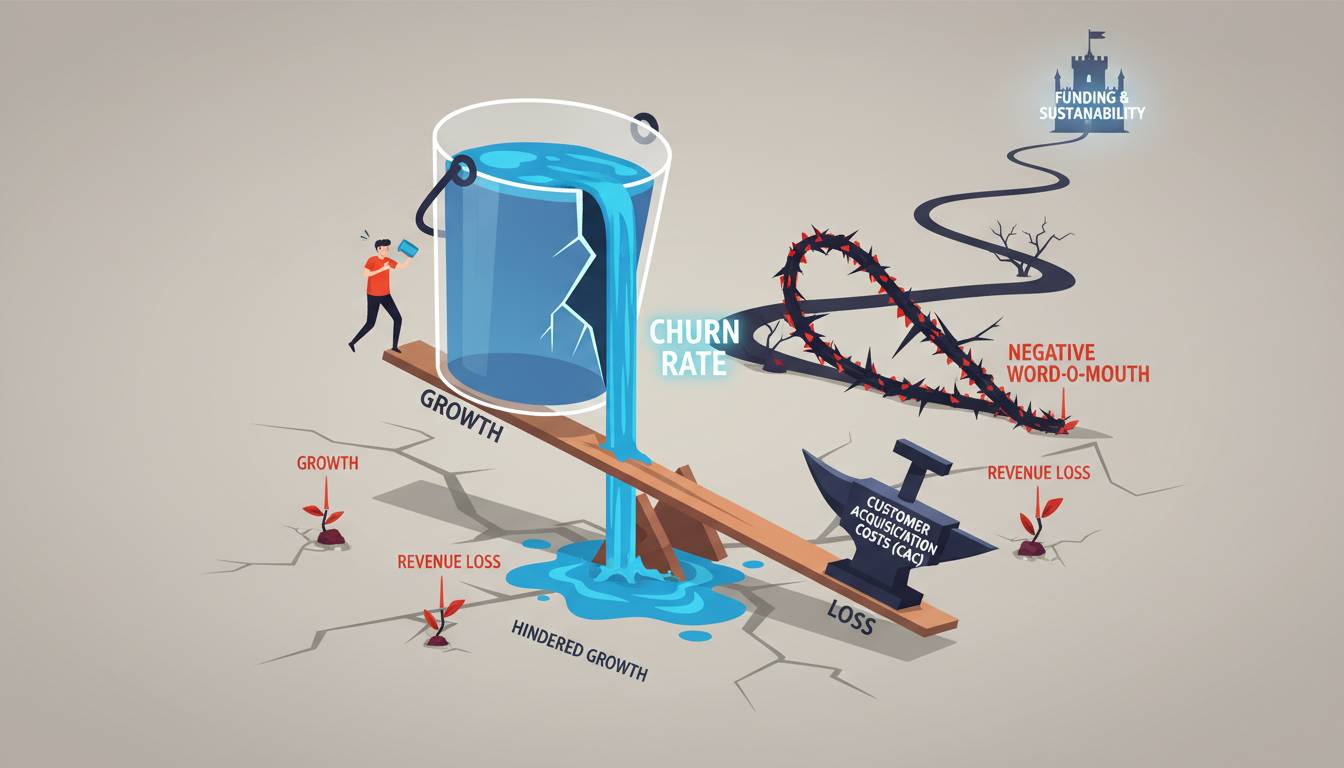
Most founders obsess over user acquisition. They celebrate every new signup, crow about growth metrics in investor meetings, and pour resources into marketing campaigns. But there’s one metric that quietly determines whether their startup survives or dies — and most don’t pay enough attention to it until it’s too late.
Churn rate is the canary in the coal mine. It’s the number that tells you whether your product is actually delivering value or whether you’re just burning through leads faster than you can replace them. Ignore it, and you’ll find yourself in a death spiral where you’re constantly acquiring new customers just to stand still.
This guide breaks down what churn rate actually means for startups, what the benchmarks really look like across different stages, and most importantly — when you should panic. I’ve seen founders dismiss red-flag churn because they didn’t know what “dangerous” looked like. Don’t be that founder.
What Is Churn Rate? The Definition That Actually Matters
Churn rate measures the percentage of customers or revenue you lose during a specific time period. That’s the textbook answer. But here’s the part most articles skip: how you calculate and interpret churn completely changes what the number tells you about your business.
The basic formula is:
Churn Rate = (Customers Lost During Period ÷ Total Customers at Start of Period) × 100
If you started January with 1,000 customers and ended with 950, you lost 50 customers. That’s a 5% monthly churn rate. Simple math. The problem is that most startups don’t calculate it this way — and when they do, they misinterpret the result.
The critical distinction is that churn isn’t just about counting customers leaving. It’s about understanding why they’re leaving and what that departure costs you. A 5% monthly churn rate means you’re losing 5% of your customer base every thirty days. Over a year, that compounds to roughly 46% of your entire customer base walking out the door. Most founders never do the math on what their monthly churn looks like annualized. If you did, you’d lose sleep.
There’s also revenue churn, which tracks the dollar value lost rather than customer count. A startup losing one enterprise client who pays $50,000 annually has a much different churn problem than one losing fifty small-business customers paying $50 each. Revenue churn tells you more about financial health. Customer churn tells you more about product-market fit. You need both.
The Two Types of Churn Most People Confuse
Here’s where founders consistently get into trouble: they track only one type of churn and think they have the full picture. They don’t.
Customer churn (sometimes called logo churn) counts the number of customer accounts that cancel or fail to renew. It’s a headcount. Revenue churn measures the actual dollar amount lost from cancellations, downgrades, or non-renewals. These two metrics can tell completely different stories.
Consider this scenario. Your startup has 100 customers: 90 paying $100/month and 10 paying $1,000/month. During February, you lose ten of the $100 customers and one of the $1,000 customers. Your customer churn is 10% — terrifying, right? But your revenue churn is only about $2,000 lost from $19,000 in monthly revenue, roughly 10.5%. The ratio is similar here, so no big deal. Now flip it. You lose just one $1,000 customer but keep all ninety $100 customers. Your customer churn is 1%. Outstanding! But your revenue churn is $1,000 from $19,000, or about 5.26% — five times worse than the customer churn suggested.
This happens in real startups all the time. The small customers leave first because they have less investment in your product. The enterprise clients stick around longer because switching costs are higher. By only tracking customer churn, you’d celebrate while your revenue quietly bleeds out.
Smart startups track both metrics monthly. They also track churned MRR (monthly recurring revenue), which shows exactly how much predictable revenue disappeared. If you’re raising a Series A, investors will ask about net revenue retention. If that’s above 100% — meaning expansion revenue from existing customers exceeds churned revenue — you’re in exceptional territory. Most startups never reach that number.
What Is a Good Churn Rate for a Startup? The Honest Benchmarks
Every article online gives you a different benchmark range. Some say 5% monthly is good. Others claim 2% is the ceiling. Here’s the uncomfortable truth: it depends entirely on your stage, your model, and your context.
According to data from OpenView’s annual SaaS benchmarks, the median monthly churn rate for SaaS startups is between 3% and 5%. That means half of all startups perform worse than this, half perform better. But “median” isn’t “good.” It’s just the middle of the pack.
For early-stage startups (pre-seed through seed, typically under $1M ARR), churn benchmarks are different because your denominator is small and your customer base is volatile. A monthly churn rate of 7-10% isn’t unusual if you’re still figuring out product-market fit. In fact, high churn at this stage often indicates you’re iterating quickly and identifying what doesn’t work. What matters more than the absolute number is whether it’s trending down over time.
For Series A stage startups ($1M to $10M ARR), you should be targeting 5% monthly churn or below. At this point, you’ve presumably found some product-market fit, and your sales and marketing machinery should be producing more consistent retention. Investors at this stage look for churn trending downward quarter over quarter.
For growth-stage startups (Series B and beyond, above $10M ARR), 2-3% monthly churn is the standard expectation. At scale, your customer acquisition costs have risen, so you can’t afford to bleed customers the way you could when you were small. Your existing customer base should be generating expansion revenue through upsells and cross-sells, making net revenue retention your key metric.
B2B SaaS companies typically have lower churn than B2C subscription businesses. Enterprise-focused startups often see 1-2% monthly churn because switching costs are higher and contracts are longer. Consumer-facing subscriptions — think mobile apps, streaming services, or direct-to-consumer products — face 5-8% monthly churn as the norm because customer lock-in is lower and alternatives are abundant.
YC, in their startup metrics advice, has repeatedly told founders that monthly churn above 10% is a “red flag” and that 7% monthly is the danger zone where most startups start drowning. That’s the threshold where you’re replacing more customers than you’re acquiring — a death spiral by any other name.
What’s Actually Considered a Dangerous Churn Rate?
Here’s the number that should make you nervous: 10% monthly churn. That’s the point where you’re losing more than one in ten customers every single month. At that rate, in four months, you’ve lost a third of your entire customer base. In eight months, you’ve lost more than half.
At 10% monthly churn, even if you acquire new customers at the same rate you’re losing them, you’re standing still. But acquisition costs almost always exceed retention costs. So you’re burning more cash to stay in place. Most startups can’t sustain that for long.
The danger compounds because churn is exponential, not linear. A 10% monthly churn means you’ve lost 71% of your customers by the end of year one. Not 120% (which would be impossible). 71%. That’s the math of exponential decay. Your customer base doesn’t just shrink — it evaporates.
But here’s what’s worse than a high churn rate: a stable churn rate that should be declining but isn’t. If you’re six months past product launch and your churn hasn’t improved, that’s a red flag. If you’re a year into Series A fundraising and your churn is flat, investors will notice. They expect improvement. They expect you to be learning from every churned customer and fixing the problems that cause them to leave.
Certain warning signs demand immediate attention. Churn concentrated in a specific customer segment suggests a product problem for that use case. Churn that’s higher among newer customers than longer-tenured ones indicates onboarding failures — people aren’t seeing value fast enough. And churn that spikes after price increases means you’ve mispriced your product and created buyer’s remorse.
The most dangerous churn scenario is one you don’t measure at all. I can’t tell you how many founders tell me they “don’t really track churn” when I ask. That’s not humility. That’s negligence. You cannot fix what you don’t measure.
How to Calculate Churn Rate (With Real Numbers That Show the Math)
Let’s walk through this with actual numbers, because formulas mean nothing without context.
Customer Churn Calculation:
Starting customers: 500
Ending customers: 460
Customers lost: 40
Customer churn rate = (40 ÷ 500) × 100 = 8%
You lost 8% of your customer base this month.
Revenue Churn Calculation:
Starting MRR: $50,000
Ending MRR: $46,500
Churned MRR: $3,500
Revenue churn rate = ($3,500 ÷ $50,000) × 100 = 7%
You lost 7% of your monthly recurring revenue.
Notice these numbers can diverge. In this example, you lost fewer percentage points of revenue than customers, suggesting your lower-value customers churned first. That’s actually good news — you want revenue churn to be lower than customer churn, because it means you’re retaining your higher-value accounts.
One more calculation worth understanding: Net Revenue Retention (NRR).
Starting MRR: $50,000
Churned MRR: $3,500
Expansion MRR (upsells, cross-sells): $5,000
Ending MRR: $51,500
Net Revenue Retention = (($46,500 + $5,000) ÷ $50,000) × 100 = 103%
This is the metric that makes investors excited. Even after losing $3,500 in churn, you grew your revenue by $1,500 through expansion. You’re more valuable today than you were last month, despite some customers leaving. Companies with NRR above 120% are exceptional and command premium valuations.
Here’s the counterintuitive truth most founders miss: a startup with 5% monthly churn but zero expansion revenue is in worse shape than one with 7% monthly churn and strong upsells. The second one is learning how to grow from existing customers. The first one is just hoping acquisition solves all problems. It never does.
Why Monthly Churn vs Annual Churn Changes Everything
Most startup articles talk about monthly churn because it’s more actionable. You find problems faster. But here’s the perspective shift that changes how you communicate with investors and think about your business: annual churn percentages are terrifying in a way monthly numbers aren’t.
A 5% monthly churn seems manageable. Nobody panics over 5%. But 5% monthly churn compounded over twelve months equals approximately 46% annual churn. You’re losing nearly half your customers every year. To maintain any growth at all, you need to acquire new customers at a rate that replaces everyone who left — plus your growth target on top.
This is why cohort analysis matters. Look at customers who started in January 2024. Where are they twelve months later? If you have a cohort of 1,000 customers from January and only 540 remain by January of the following year, your annual retention rate is 54%. That’s a 46% annual churn. Most startups are horrified when they see this number for the first time, because the monthly view had masked the severity.
The startup rule of thumb: if your annual churn exceeds 60%, your business model is fundamentally broken. It doesn’t matter how much venture capital you raise or how aggressive your marketing is. You’re on a treadmill that gets faster every year. Acquisition costs rise, retention gets harder, and eventually the math fails.
This is also why customer lifetime value (LTV) calculations matter. If your average customer pays you $1,000 over their lifetime but it costs you $800 to acquire them, your LTV:CAC ratio is 1.25 — barely profitable. But if that same customer churns in six months instead of staying for two years, your effective LTV drops to $300, and now you’ve lost money on every customer. Churn doesn’t just kill growth. It destroys unit economics.
The Hidden Metric That Actually Matters More Than Churn
Here’s an opinion that will ruffle feathers in startup circles: obsession with churn rate alone is a distraction. The metric that actually determines your fate is net revenue retention combined with customer concentration risk.
I say this because you can have a perfectly acceptable 5% monthly churn rate and still fail. How? If your top 10 customers represent 80% of your revenue and you lose three of them in a quarter, your “acceptable” churn just took your business off a cliff. Churn is an average. Averages hide extremes.
The real question isn’t “what’s our churn?” It’s “what would happen if our five biggest customers left tomorrow?” If that question keeps you up at night, your churn metrics are misleading you. Diversification matters more than the headline number.
Similarly, the distinction between voluntary and involuntary churn matters more than most founders realize. Voluntary churn is a customer choosing to leave — they found something better, they got acquired, they went out of business. That’s largely outside your control. Involuntary churn is a payment failure, a credit card expiring, a billing error. That’s within your control, and it’s often 20-30% of total churn. Fixing involuntary churn can improve your metrics significantly without changing anything about your product.
A close friend ran a SaaS company that obsessed over their 4% monthly churn. They hired a customer success team, invested in retention programs, everything. Then someone finally looked at the data and realized 40% of their churn was payment failures — cards expiring, bank declines, failed retries. They fixed their billing system, implemented dunning automation, and dropped effective churn by almost half without changing the product at all. Their headline churn rate improved, and they hadn’t actually retained a single additional happy customer. That’s the trap of optimizing metrics without understanding what drives them.
Common Churn Rate Mistakes Startups Make
First, they calculate churn on the wrong denominator. Using average customers during the period instead of customers at the start understates churn when you’re growing fast. Using customers at the end overstates it when you’re shrinking. The standard approach is start-of-period customers, but acknowledge this explicitly in your reporting.
Second, they ignore churn in cohorts. Aggregate churn hides problems. A 5% average might mask a segment at 15% and another at 1%. Segment your churn by customer size, acquisition channel, product tier, or geography. You’ll find the problem.
Third, they celebrate acquisition as a churn fix. Adding more customers doesn’t reduce churn — it masks it. Your churn percentage stays the same even as your total customer count grows. But your absolute number of churned customers increases. Eventually, that catches up.
Fourth, they measure activity instead of outcomes. Tracking “support tickets resolved” or “onboarding calls completed” feels productive. But the only metric that matters is whether customers stay and pay. Everything else is noise.
Fifth, they delay churned customer interviews. Most startups don’t talk to customers who cancel. Big mistake. The feedback is gold. Every churned customer knows something about why your product failed them. If you’re not systematically gathering and acting on that feedback, you’re losing an unfair advantage.
How to Reduce Your Startup’s Churn Rate
I won’t pretend there’s a secret formula that eliminates churn. If there were, every startup would be perfect. But there are concrete approaches that work when applied consistently.
Map your customer journey and identify the moment people disengage. Most B2B SaaS churn happens in the first 90 days — the “first friction window.” If users don’t achieve their first meaningful outcome within that timeframe, they churn. That’s an onboarding problem, not a product problem. Fix it by building better setup wizards, creating success milestones, and proactively reaching out to users who haven’t reached activation.
Segment your customers and identify early warning signals. If usage drops 30% from a customer’s baseline, that’s a churn predictor. Build alerts. Have customer success teams reach out before the customer decides to leave. The “at-risk” intervention is far more effective than the “churned” recovery attempt.
Invest in product-led growth mechanisms that create switching costs. Integrations, data accumulation, team collaboration — these things make leaving harder. The more embedded your product is in how a customer operates, the lower your churn.
Finally, measure churn weekly, not monthly. Monthly metrics are too slow for intervention. Weekly gives you time to act. And when you see churn spike, investigate immediately. Don’t wait for the end-of-month report.
Final Thoughts: The Metric You Can’t Afford to Ignore
Churn isn’t just another startup metric. It’s the most honest reflection of whether you’re building something people actually want. You can fake user growth for quarters. You can inflate engagement numbers with vanity metrics. But you can’t fake customers who pay you money and then decide to stop.
The dangerous churn rate isn’t a single number — it’s the point where churn prevents you from growing profitably and compounds against you faster than acquisition can replace. For most startups, that’s somewhere around 7-10% monthly. But the real danger is operating without knowing your numbers at all.
Calculate your churn. Calculate it correctly — both customer and revenue. Segment it. Analyze it weekly. And most importantly, remember that churn is a symptom, not the disease. Fix the underlying product problems, onboarding failures, and customer experience gaps that cause people to leave, and the numbers will improve. Ignore them, and no amount of growth hacking will save you.
