
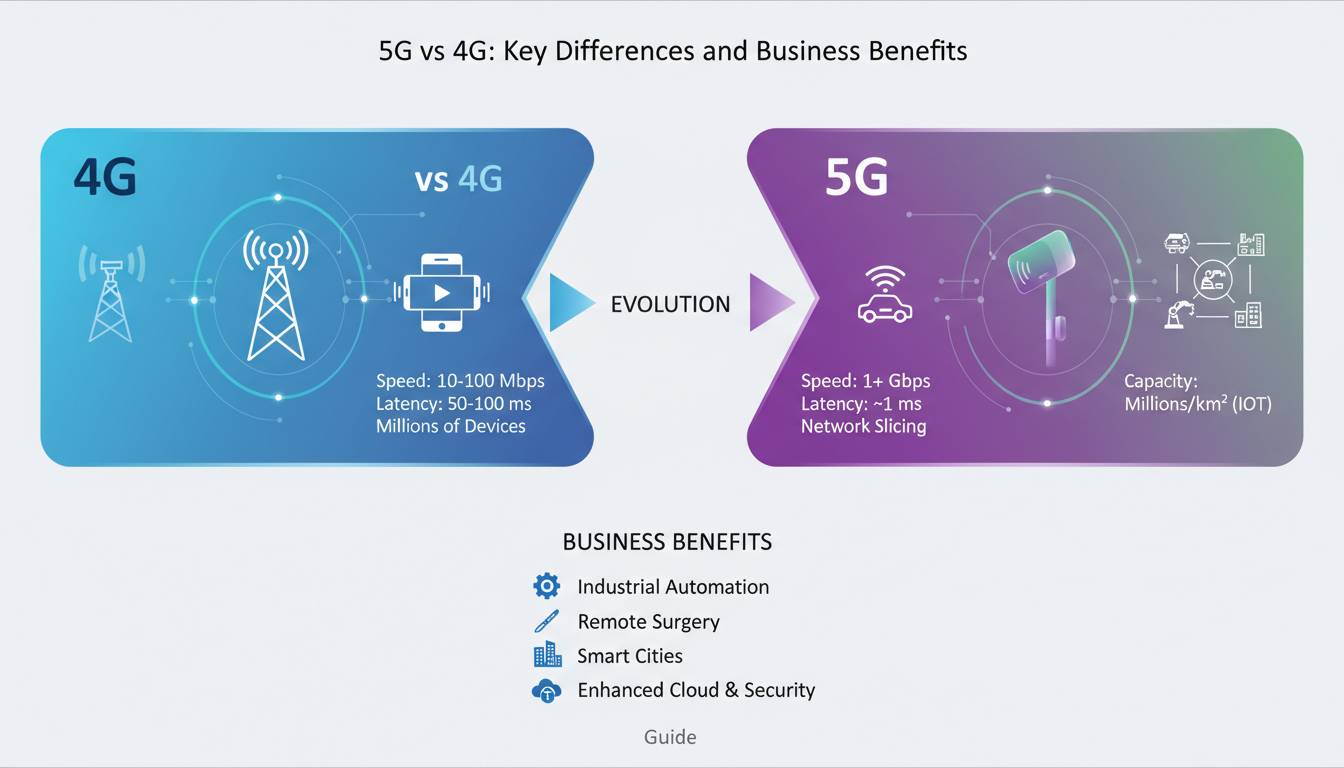
The conversation about 5G in business circles has shifted. We’re no longer asking whether 5G matters — we’re asking what it actually enables that 4G cannot, and more importantly, when the math justifies the investment. The distinction between these two generations of wireless technology isn’t merely incremental. It represents a fundamental shift in what’s possible for enterprises willing to rethink their connectivity architecture. This guide breaks down the technical realities, separates marketing from substance, and examines the concrete business applications that are driving early adoption across industries.
Technical Architecture: Why 5G Isn’t Just Faster 4G
The differences between 5G and 4G extend far beyond speed benchmarks, though those numbers are impressive. At the architectural level, 5G was designed with a fundamentally different approach to spectrum utilization, network slicing, and device density. Understanding these differences is essential for business leaders evaluating their connectivity strategy.
Spectrum and Frequency Allocation
4G networks operate primarily in frequencies below 6 GHz, a range that became increasingly congested as data demands grew. 5G introduces access to much higher frequency bands — specifically the millimeter wave (mmWave) spectrum between 24 GHz and 100 GHz — alongside continued use of sub-6 GHz frequencies. This dual-layer approach is what makes 5G technically distinct.
The trade-off is straightforward: mmWave delivers extraordinary speeds and capacity but travels short distances and struggles with physical obstacles like walls and foliage. Sub-6 GHz 5G offers moderate speed improvements over 4G but with better coverage characteristics. Carriers like AT&T and Verizon have deployed both, with Verizon initially focusing heavily on mmWave in dense urban areas before expanding sub-6 GHz availability.
For businesses, this means evaluating what each band actually delivers in their specific locations rather than accepting carrier marketing at face value. A manufacturing facility in a suburban area may find that sub-6 GHz 5G provides the right balance of coverage and performance, while a financial trading floor in Manhattan might genuinely benefit from mmWave’s ultra-low latency characteristics.
Network Architecture Differences
5G uses a service-based architecture that replaces the traditional node-based approach of 4G. This matters for business applications because it enables network slicing — the ability to create multiple virtual networks optimized for different use cases on a single physical infrastructure. A hospital could theoretically operate one slice optimized for critical communications with guaranteed low latency alongside another slice handling less sensitive administrative traffic, all on the same 5G network.
This architectural flexibility is something 4G simply cannot replicate. The previous generation was designed primarily for mobile broadband with a one-size-fits-all approach to network resources.
Speed, Latency, and Capacity: The Numbers That Matter
Carriers love to advertise theoretical maximum speeds, but understanding what businesses actually experience requires looking at realistic performance metrics across different deployment scenarios.
Real-World Speed Comparisons
The International Telecommunications Union (ITU) established 5G specifications calling for peak download speeds of up to 20 Gbps, compared to 4G LTE’s theoretical maximum of 1 Gbps. However, these numbers represent ideal laboratory conditions. Real-world 5G speeds vary dramatically based on spectrum band, network congestion, and physical environment.
Opensignal’s 2024 analysis of user-experienced speeds found that 5G users in the United States averaged download speeds between 150 Mbps and 250 Mbps on sub-6 GHz networks, with mmWave deployments occasionally exceeding 500 Mbps in optimal conditions. By comparison, 4G LTE speeds typically ranged from 20 Mbps to 50 Mbps across the same markets. The gap is significant but falls far short of the theoretical 20x improvement carriers sometimes suggest.
What matters more for business planning is not the headline number but the consistency and reliability of performance under actual usage conditions. Enterprises considering 5G should conduct site-specific speed tests in their operational environments rather than relying on carrier coverage maps, which often overestimate actual performance.
Latency: The Business-Critical Metric
Latency — the time it takes data to travel from source to destination — is where 5G’s business case becomes genuinely compelling. 4G networks typically deliver latency between 50ms and 100ms. 5G specifications target 1ms latency for enhanced mobile broadband, with the 3GPP Release 16 standards introducing ultra-reliable low-latency communication (URLLC) capabilities designed for mission-critical applications.
For most business applications, the practical difference between 50ms and 10ms latency is negligible. However, for real-time control systems, automated guided vehicles in warehouses, remote-controlled machinery, and certain healthcare applications, the sub-10ms latency that 5G can deliver in optimal conditions creates genuine operational possibilities that 4G cannot support.
Qualcomm’s testing has demonstrated 5G latency under 5ms in controlled environments, though real-world deployments typically see 10-20ms on the edge of coverage areas. The key insight for business decision-makers is that latency improvements are not uniform — they depend heavily on network deployment quality, distance from cell sites, and whether the data traffic is prioritized on the network.
Network Capacity and Device Density
The number of connected devices 4G networks can support per square kilometer creates hard limits for enterprises pursuing IoT at scale. 4G LTE Advanced networks support approximately 10,000 to 100,000 devices per square kilometer. 5G specifications target support for up to one million devices per square kilometer — a 10x to 100x improvement in connection density.
This capacity improvement addresses a real constraint that businesses encounter when deploying large-scale IoT implementations. A smart factory with thousands of sensors, automated systems, and employee devices quickly approaches 4G network limits during peak operational periods. 5G’s enhanced capacity provides headroom for ambitious digital transformation initiatives that would overwhelm 4G infrastructure.
Ericsson’s mobility report projected that 5G networks would handle over 60% of global mobile data traffic by the end of 2024, a shift driven primarily by capacity improvements rather than speed alone.
What 5G Enables for Business: Practical Applications
The technical differences translate into business capabilities when organizations design applications specifically for 5G’s strengths. Several industries are already demonstrating what’s possible.
Manufacturing and Industrial Automation
The manufacturing sector represents perhaps the most mature 5G business use case. BMW’s facility in Spartanburg, South Carolina, deployed 5G networks to support real-time quality inspection systems that analyze components as they move through production lines. The sub-10ms latency enables immediate feedback and rejection of defective parts before they proceed to subsequent assembly stages — a capability that would be impractical with 4G’s latency characteristics.
Similarly, Siemens has partnered with carriers to demonstrate 5G-connected industrial robots that respond to human operators in real time, enabling new collaboration models between factory workers and automated systems. These applications require the combination of low latency, high reliability, and substantial bandwidth that 5G provides.
The challenge for manufacturers is that 5G alone doesn’t deliver these outcomes. The network enables the possibility, but success requires investment in edge computing infrastructure, application development, and systems integration. Treating 5G as a magic solution rather than one component of a broader digital transformation initiative leads to disappointing results.
Healthcare and Remote Medical Applications
Healthcare organizations are exploring 5G for applications ranging from remote diagnostics to augmented reality-assisted surgery. In 2023, Johns Hopkins physicians performed the first 5G-connected remote surgery demonstration in the United States, controlling robotic instruments with latency imperceptible to human perception. While such applications remain experimental, the technology foundation now exists for teleconsultation, remote patient monitoring, and hospital operations that depend on real-time data transmission.
The critical insight for healthcare executives is that 5G’s value in medical settings often comes from reliability and consistency rather than raw speed. A momentary network hiccup that might be annoying when streaming video becomes potentially dangerous in a clinical context. Healthcare-specific 5G deployments typically prioritize network slicing and quality-of-service guarantees over maximizing bandwidth.
Retail and Customer Experience
Retailers are using 5G to enable immersive customer experiences that 4G networks cannot support effectively. Walmart deployed 5G in select stores to support sophisticated inventory management systems that track merchandise in real time using IoT sensors and computer vision. The network’s capacity enables continuous scanning of thousands of items across large retail spaces without the congestion issues that would plague 4G deployments at similar scale.
Augmented reality shopping experiences, which overlay digital information onto physical store environments, benefit from 5G’s reduced latency. Customers using AR applications expect instant response to their movements — delays break immersion and reduce perceived value. Several major retailers have reported that 4G networks simply cannot deliver the responsiveness these experiences require.
Logistics and Supply Chain
Port operations represent an emerging 5G use case with substantial economic impact. The Port of Rotterdam in the Netherlands deployed 5G to support automated container handling, real-time tracking of thousands of shipping containers, and coordination between automated guided vehicles and human operators. The network’s capacity and reliability enable operational densities that would be impossible with 4G, directly improving throughput and reducing vessel turnaround times.
Similar deployments are underway at ports in Los Angeles, Hamburg, and Singapore, suggesting a clear pattern where 5G’s technical advantages translate into measurable supply chain efficiency improvements.
Implementation Considerations: The Real-World Challenges
Acknowledging limitations and challenges distinguishes genuine expertise from marketing material. 5G implementation for business involves several factors that often receive insufficient attention in vendor presentations.
Coverage Reality Check
5G coverage remains significantly less comprehensive than 4G, particularly for the mmWave deployments that deliver the most dramatic performance improvements. As of early 2025, sub-6 GHz 5G covers approximately 85% of the U.S. population according to carrier announcements, but mmWave coverage remains limited to specific urban corridors, stadiums, airports, and venues. Enterprises cannot assume 5G availability based on carrier marketing materials — physical site surveys are essential.
The practical implication is that most businesses will operate in hybrid environments where some locations have 5G coverage and others do not. Application architectures must gracefully handle this reality, falling back to 4G or Wi-Fi when 5G is unavailable without disrupting operations.
Device and Hardware Ecosystem
The device ecosystem has matured substantially since 5G launch, but enterprises with large device fleets face compatibility challenges. Legacy equipment designed exclusively for 4G requires hardware upgrades or gateway solutions to connect to 5G networks. For organizations with extensive IoT deployments, this represents a significant capital expense that must be factored into business case calculations.
Additionally, not all 5G devices are created equal. Enterprise-grade 5G modems and modules from companies like Qualcomm, Sierra Wireless, and Telit offer capabilities beyond consumer-grade chips, including enhanced temperature ranges, industrial certifications, and advanced power management. Choosing the right device class for specific business applications requires understanding these distinctions.
Cost Considerations
5G implementation involves costs at multiple levels: network infrastructure, internal expertise, device procurement, and ongoing service expenses. Carrier 5G business plans typically cost more than equivalent 4G services, though pricing structures vary. Enterprises must evaluate whether the specific capabilities 5G provides — low latency, high capacity, network slicing — justify the premium for their particular use cases.
The honest assessment is that many business applications work perfectly well on 4G. A point-of-sale system, basic video surveillance, or standard conference calling does not require 5G’s advanced capabilities. Investing in 5G for applications that don’t genuinely need its technical advantages represents a misallocation of capital. The key is identifying specific use cases where 5G’s attributes create genuine value, rather than adopting 5G as a general principle.
The Future Trajectory: What Lies Ahead
The 5G ecosystem continues evolving, with the 3GPP Release 18 standards (sometimes called 5G Advanced) introducing additional capabilities that will further expand business possibilities.
5G Advanced Capabilities
Release 18 brings improvements in several areas relevant to enterprise applications. Better positioning accuracy — potentially achieving sub-centimeter location precision in ideal conditions — opens possibilities for indoor navigation, asset tracking, and autonomous system coordination that weren’t feasible with earlier 5G specifications.
Extended reality (XR) support improvements address the demanding requirements of virtual and augmented reality applications, which require sustained high bandwidth combined with extremely low latency. While consumer XR applications remain nascent, enterprises in manufacturing, healthcare, and training are actively developing use cases that depend on these capabilities.
Integration with Edge Computing
The convergence of 5G with edge computing represents perhaps the most significant near-term opportunity for businesses. By processing data at the network edge rather than transmitting it to centralized cloud infrastructure, organizations can achieve the low latency that real-time applications require while maintaining the security, sovereignty, and economic advantages of localized processing.
Carriers and cloud providers are aggressively building edge infrastructure. AWS Wavelength, Azure Edge Zones, and Google Distributed Cloud all offer integrated 5G plus edge computing solutions designed specifically for enterprise workloads. The businesses that succeed with 5G will likely be those that design their applications to leverage this edge architecture rather than treating 5G as a simple connectivity replacement.
Frequently Asked Questions
What are the main differences between 5G and 4G?
The primary differences involve speed, latency, capacity, and network architecture. 5G offers substantially higher peak speeds (up to 20 Gbps theoretically versus 1 Gbps for 4G), significantly lower latency (targeting 1ms versus 50-100ms for 4G), and dramatically higher device density (up to one million devices per square kilometer versus 10,000-100,000 for 4G). Additionally, 5G’s service-based architecture enables capabilities like network slicing that 4G cannot provide.
How much faster is 5G than 4G in real-world use?
Real-world 5G speeds typically range from 150 Mbps to 500 Mbps depending on spectrum band and network conditions, compared to 20-50 Mbps for 4G LTE. This represents roughly a 3-10x improvement in actual experienced speeds, which falls well short of the theoretical 20x improvement sometimes advertised. Performance varies significantly by location, carrier, and time of day.
What business applications does 5G enable that 4G cannot support?
5G enables real-time industrial automation, immersive augmented reality experiences, large-scale IoT deployments, remote surgery applications, and precision positioning systems that require sub-10ms latency or extremely high device density. Not every business application requires these capabilities — many functions work perfectly well on 4G — but industries like manufacturing, healthcare, logistics, and retail have specific use cases that depend on 5G’s technical advantages.
When should businesses adopt 5G?
Businesses should evaluate 5G adoption when they have specific applications that genuinely require 5G’s technical capabilities — particularly sub-10ms latency, very high device density, or network slicing for differentiated service levels. Organizations should conduct site surveys to verify 5G coverage in their operational locations, evaluate device and infrastructure costs against expected benefits, and develop realistic timelines for migrating applications rather than adopting 5G as a general upgrade.
Looking Forward: The Question That Remains Unanswered
The technical case for 5G in business is clear in specific contexts, but the broader strategic question remains genuinely open. Will 5G become the default enterprise connectivity platform, displacing Wi-Fi and 4G for most business applications? Or will it remain a specialized solution for specific high-performance use cases while Wi-Fi continues to handle the majority of enterprise connectivity needs?
The answer likely depends on how quickly edge computing ecosystems mature, how carrier pricing evolves, and whether application developers create genuinely 5G-native experiences that demonstrate capabilities users can’t get any other way. What’s certain is that the decision requires understanding the actual technical differences rather than accepting marketing claims, identifying specific business problems that 5G uniquely solves, and building implementation plans that acknowledge real-world constraints around coverage, cost, and complexity.
The organizations that approach 5G with clear-eyed analysis of its genuine capabilities and limitations will make better investment decisions than those seduced by the technology’s promise without understanding its practical boundaries.
